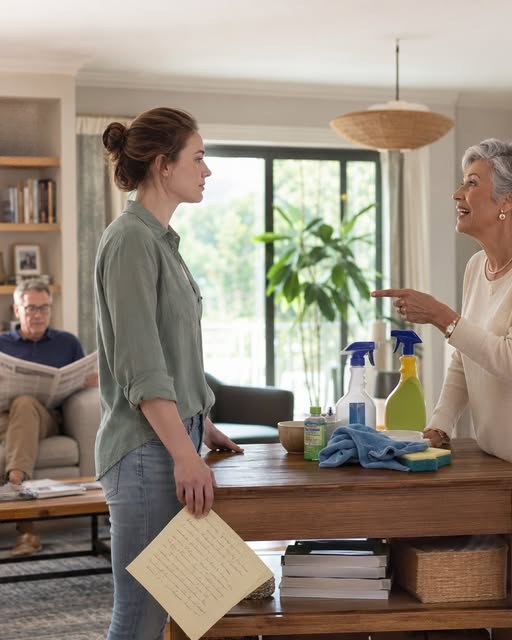
My mother slid a sheet of paper across the counter. “Cook for 30. Clean before and after.”
My name is Morgan Callaway. I’m thirty-six. I work as a freelance event planner in Austin, Texas, and I’m very good at what I do. Clients pay me. They thank me. They recommend me. Sometimes I even get holiday notes or a bottle of wine with messages like, “The event was perfect. You made it effortless.”
My mother doesn’t send notes like that. She sends instructions.
The one she gave me on a Saturday morning in April was written on soft cream paper in her precise cursive. Careful loops, even spacing, the kind of handwriting that feels like discipline disguised as beauty. Thirty-seven tasks. Two days. Cook for thirty people. Clean everything before and after. Set up the patio by three. Test sound by four. Chill drinks by five. Iron linens. Arrange decorations. Prepare pulled pork, coleslaw, bean salad, lemon bars, sweet tea—and a backup batch because she always runs out. Her guests drink it like water.
At the bottom, underlined twice: My sister’s engagement party must be perfect.
I read it twice. Not because I needed to. I’ve been receiving versions of this since I was in my early twenties. I could reconstruct it from memory. I read it again because I needed to confirm it was still real. That after years of doing all the planning, cooking, cleaning, setting up, breaking down, and driving home alone to eat leftovers standing in my kitchen, there still wasn’t a single line that said, “Sit down and enjoy it.”
So I asked, “Where do I sit?”
She laughed. Not cruelly. That’s the part people misunderstand. She isn’t sharp in a visible way. It’s effortless. The kind of laugh you give when someone asks something obvious.
“You don’t,” she said, already turning back to the counter. “It’s not difficult, Morgan.”
That phrase again. Not difficult. Set tables. Cook for thirty. Run a full event and then disappear into the background. Not difficult.
Technically, she’s right. None of it is difficult. I manage large corporate events with strict budgets and impossible schedules. A backyard party for thirty is simple. What isn’t simple is doing it for fifteen years without pay, recognition, or a seat.
My father sat at the kitchen table reading the newspaper. He heard everything. He didn’t look up. His hand turned the page with mechanical patience, the kind you develop when ignoring things becomes a lifestyle.
I looked at him for a few seconds. Nothing.
I folded the paper, slipped it into my pocket, and smiled. Not happiness. Calculation.
“I’ll get the supplies,” I said.
I drove back to my apartment on South Lamar. Clean space. Too clean for some people. Everything labeled, sorted, controlled. My kitchen had two chairs. One had never been used by anyone else.
I sat at the table and opened my notebook. Leather cover. Always with me. Inside: forty-seven events tracked in detail. Costs, vendors, timelines, hours. I’ve never shown it to anyone. It wasn’t emotional. It was just structure.
I flipped to the most recent entry: Saturday. 7:45 PM flight from Austin to San Diego.
I closed it.
Then I looked around my apartment. Label maker. Storage bins. A single mug drying. I’d spent fifteen years planning other people’s events. It took me six weeks to plan leaving them.
Before Saturday, there was something I needed to explain.
A certificate. Fifth grade. Achievement award. Still folded in a shoebox in my closet for twenty-four years.
I earned it at twelve. Walked across a gym stage. Heard applause. Looked for my mother in the crowd. Row two. Third seat.
It was empty.
My sister Kayla was there. So was my aunt. My mother wasn’t.
Afterward, she told me she had to pick up a dress. That was it. No apology that mattered.
I put the certificate away and never mentioned it again.
That certificate is why I’m on a plane now. And why thirty people are standing at an empty house tonight.
Years passed. I built a career. Came back to Austin. Started over professionally. My mother called that first Thanksgiving.
“Can you help me with dinner?”
Help. That word. Not plan. Not run. Just help.
I said yes.
Two days in her kitchen. I cooked everything. Turkey, sides, desserts. She poured tea. When guests arrived, she stood and said she had worked all day.
No one looked at me.
That was the beginning. The first of many.
Over time, it became routine. Every holiday. Every birthday. Every gathering. People praised her. They never asked questions. She believed it. I enabled it.
My sister once asked why I was always in the kitchen.
“Because someone has to be,” I said.
She accepted that answer. So did everyone else.
Years later, I met someone who noticed things. Owen. A teacher. He saw patterns I had stopped questioning. How I worked for everyone but myself.
“You don’t live your life,” he told me once. “You manage everyone else’s.”
He wasn’t wrong. That was the end of us.
But the truth still didn’t change anything.
What did was Courtney.
She came to one Thanksgiving. Watched everything. Helped me wash dishes afterward. Then asked, “Why do you let them treat you like this?”
I said it was family.
She said, “That’s not family. That’s labor.”
I stopped talking to her for months after that. Because she was right.
Eventually I came back. She didn’t hold it against me. That’s how she is. She tells the truth. Then waits.
After that, I started tracking time. Hours. Labor. Cost. Not because I knew what I was doing with it yet. But because I needed proof.
Years passed. More events. More expectations. More silence.
Then six months ago, something changed. A question started repeating itself.
What if you planned something for yourself?
I ignored it at first. Then it stayed.
When my mother called about my sister’s engagement, she said it like always. We need your pulled pork. We need your setup. We need your system.
My recipe. My work. My everything.
I said yes.
Then I created a folder on my laptop.
EXIT.
I started working.
Not emotionally. Logically. Like a project.
I reviewed every vendor. Every contract. Every payment. All under my name. I calculated the truth: I had been funding and executing events my mother was credited for.
I documented cancellation policies. Timelines. Refund windows.
Then I called Courtney.
“I’m building a spreadsheet,” I said.
“About what?”
“Everything I’m getting back.”
She paused. “What do you need?”
“A place to stay.”
“Already yours.”
I booked a one-way flight.
Then I prepared everything.
My mother never asked about cost. Never signed anything. Never handled logistics. She just showed up and received credit.
I handled everything else.
Two days before the event, I cooked at her house while she was out. I finished everything. Cleaned everything. Organized everything.
At night, I stood in her kitchen wearing her apron. I saw myself in the oven reflection. Not as a guest. As infrastructure.
I untied the apron. Left it folded on the counter.
That was the moment I left the job.
Saturday morning, I followed the plan.
I told her I’d take food home to finish prep. She didn’t question it. She never does.
I loaded everything into my car. Then drove to my apartment.
At noon, I made four calls.
Caterer canceled.
Rental pickup scheduled.
Florist canceled.
DJ canceled.
Eleven minutes. Fifteen years undone.
Then I waited.
At 3:30, the rental truck arrived at her house. Everything was removed.
At 5:00, she came home from the salon.
At 5:38, she started calling.
I didn’t answer.
I boarded my flight at 7:45.
Somewhere over the air, everything caught up to me. Not sadness. Not regret. Just release.
For the first time, I wasn’t going anywhere for someone else.
I was just going.
Meanwhile, at the house, everything collapsed in real time.
She arrived expecting setup. Instead: emptiness.
No tables. No food. No structure.
Guests still came. They arrived dressed for an event that didn’t exist.
They stood in confusion.
Then they left.
One by one.
Her reputation didn’t explode. It faded. Quietly. In real time.
Kayla asked where everything was.
My mother said I had taken it.
But the truth was simpler: I had been the system.
Without me, there was nothing to display.
Later, my father said one sentence:
“I’m proud of her.”
Twelve words. Too late. Still real.
Courtney picked me up at the airport.
We didn’t talk much.
We didn’t need to.
That night, we ate food on her couch. No expectations. No schedule. No list.
The next morning, I read every voicemail.
Anger. Confusion. Bargaining. Silence.
Then I deleted them.
Except one.
My father’s.
Because it was the first honest thing he had said in years.
Kayla texted: I should have seen it.
I didn’t respond right away.
Instead, I placed the fifth-grade certificate on Courtney’s shelf.
It finally had a place where it wasn’t hidden.
Later, I replied to Kayla.
Three words:
When I’m ready.
And for the first time in years, I didn’t plan what came next.
Because the truth is simple.
You don’t earn a seat at a table you built for others.
And once you stop building it, you finally find out where you actually stand.