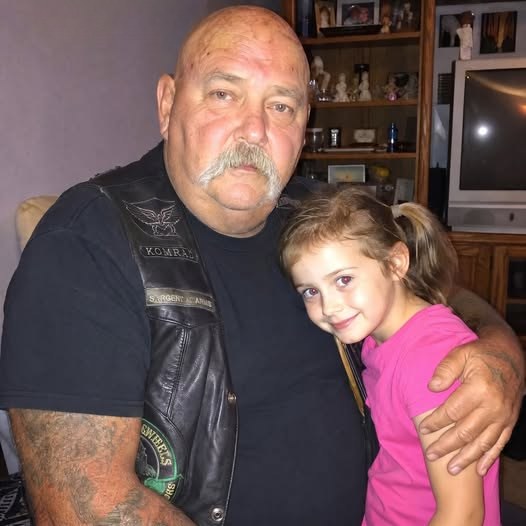
I ride with a club, and in sixty-three years I’ve made choices I’m not proud of. What happened that Tuesday morning in March isn’t one of them.
My granddaughter Lily had been in foster care for almost a year. Eleven months since my daughter — my only child — lost her battle with addiction and never came home again before Lily turned six.
The same day they took her, I applied for custody. I had a clean record, steady money from my repair shop, letters from people all over town. The judge barely looked at any of it. He looked at my vest, my ink, my life, and decided I wasn’t “fit.”
That word stuck in me like a nail.
Lily had called me Papa since she first learned to speak. She used to fall asleep against my chest while old films played, her tiny hand wrapped around my finger like she was afraid I’d vanish.
And still, I wasn’t the one allowed to keep her.
At first, the foster placement seemed fine. Then I started noticing the change. Lily got quiet in a different way. Not sadness. Fear. She stopped running to me during visits. Her eyes kept drifting toward doors, like she was expecting something behind them.
I asked her what was wrong. She shook her head.
I asked again the following week. Same silence.
On the third week, I held her hands and told her she could trust me with anything. She leaned in close and whispered four words into my ear.
I didn’t stay another minute. I drove straight to the county office and told them everything. The caseworker wrote it down, said they’d investigate.
That was Friday.
By Monday, nothing.
Tuesday morning, I put on my cut, got in my truck, and drove.
But to understand that day, you’ve got to understand everything before it.
My daughter Cara was twenty-nine when she died. She’d been fighting pills since twenty-two, after a wreck that left her injured and handed her a prescription she never should’ve stayed on. I spent years trying to pull her back. Rehab centers. Group homes. Meetings. Nights sitting in my truck outside buildings because she didn’t want people seeing her walk in with her father, but she still needed me there.
For a while, she got better. Fourteen months clean once. Long enough for hope to feel real again. She called me one Sunday just to talk — told me Lily had made pancakes, syrup everywhere, laughing in the kitchen. I actually believed we were finally past it.
Three weeks later, she was gone. Overdose in her apartment. Lily asleep in the next room. TV still on when the neighbor called it in.
I was the one who woke Lily up.
She stared at me for a long time. Then she climbed into my lap and pressed her face into my shirt. No crying. Just holding on like letting go wasn’t an option. She was five years and eight months old. Old enough to understand loss. Too young to process it.
Two hours later, they took her.
The custody hearing came just over two months after the funeral. My lawyer told me I had a strong case. I owned my shop for years, no serious record, stable home, support from half the town. I had letters from my pastor, neighbors, customers — everything you’re supposed to have.
The judge didn’t see any of that first.
He saw my vest. My tattoos. My club.
He asked if I was involved in “that lifestyle.” I told him it was a riding group, nothing criminal, just men who rode together and helped each other.
He asked about my past DUI. I told him the truth — I’d paid for it, fixed it, lived differently since.
Then he asked if I would keep living the same way if I got custody.
I said yes.
Because I wasn’t going to lie just to sound acceptable.
He denied me.
Lily was placed in temporary foster care while they “evaluated options.” They said it might take over a year.
I sat in that courtroom long after everyone left. My lawyer tried to speak. I ignored him. I went to my truck and just sat there with my head against the wheel until I could breathe again.
Then I started visiting her every supervised chance they allowed.
Thursday afternoons. Two hours. Fluorescent lights. Plastic chairs bolted to the floor. A caseworker watching from the corner like we were something to be managed.
At first, Lily ran into my arms every time. She was thinner than I remembered, but still laughed at everything. Still my girl.
Then it started slipping.
She still came to me, but differently. Less energy. Fewer words. She used to talk nonstop — stories, drawings, school gossip. Then it turned into short answers. Then silence between them. Her eyes kept checking the door.
The caseworker called it adjustment. Said kids do that.
I knew better.
It kept getting worse. She stopped eating snacks I brought. Started chewing her lip until it bled a little. One visit she had a bruise on her leg and told me she fell, but wouldn’t look at me when she said it.
I reported it. They wrote it down. Promised a follow-up.
Nothing changed.
Another report. Another promise.
Then came the Thursday she leaned into my ear.
She climbed into my lap like she always did. I held her for a moment. The worker in the corner was typing on her phone.
I told Lily she could tell me anything.
She nodded.
Then she whispered four words.
He locks my door.
I held her tighter and told her she was brave. Told her I loved her more than anything in this world. I kept my voice steady so she wouldn’t see what was breaking inside me.
After the visit, I went straight to the desk and reported it again. Same response: notes, follow-up, visit scheduled.
I asked when.
They said within a week.
I asked if she’d stay there until then.
They said yes, unless there was “emergency criteria.”
I told them I had just given them that.
They disagreed.
I left.
That night I didn’t sleep.
By Monday, still nothing.
Tuesday morning I woke up before dawn and just lay there thinking. About Lily. About locked doors. About every step I’d already taken that led nowhere.
I made coffee. Stood in the kitchen in silence.
Then I opened a drawer.
I’m not a violent man. I’ve never been one. But I took a weapon that morning because I knew no one else was coming fast enough. I didn’t take it to threaten. I took it because I needed whoever was in that house to understand I wasn’t there to talk in circles.
I drove out.
The house was ordinary. Quiet street. Clean yard. Minivan outside. Wind chime moving slightly on the porch.
A man answered the door.
Before he even spoke, I heard her.
A small sound from inside. Cut off quickly. Like someone trained not to be heard.
Everything went sharp after that.
I stepped in. Told him to move back. He did.
I followed the sound down the hallway, called her name.
A door was there with a latch on the outside.
I opened it.
She was in the corner, small and folded in on herself. When she saw me, she ran so fast she nearly knocked everything over. She grabbed me like she was afraid I’d disappear if she let go.
I kept her in one arm and controlled the situation with the other.
I carried her out, put her in my truck, and called 911 before I even started the engine.
They stopped me a few miles away in a parking lot. I didn’t resist. I got out with my hands visible. I asked them to make sure Lily was safe before anything else.
They said they would.
I spent one night in jail. My lawyer got me out quickly. Charges came down hard at first — forced entry, assault with a weapon.
Then things changed.
When police went back, they found more. Another locked room. Another child. Evidence that painted a picture no one had bothered to see earlier.
The man was arrested.
Charges against me were eventually dropped.
Months later, I got Lily back. First temporary custody, then full. The judge who returned her to me barely looked up from the file and said I had been “more than thoroughly reviewed.”
I almost laughed too.
Lily is nine now.
She’s loud in the mornings, complains about swimming lessons, laughs suddenly and completely like her mother used to. She still sleeps with a light on. She still calls me Papa. She still climbs into my truck after school and talks nonstop about everything that matters to her at that age.
Sometimes she falls asleep against me again. Her hand still finds my finger like it used to.
I don’t move when that happens.
People ask me if I regret it. If I’d do it again knowing what it cost.
I tell them the same thing I told the officer that day.
I knocked first.
And yes — every time, I would do it again.