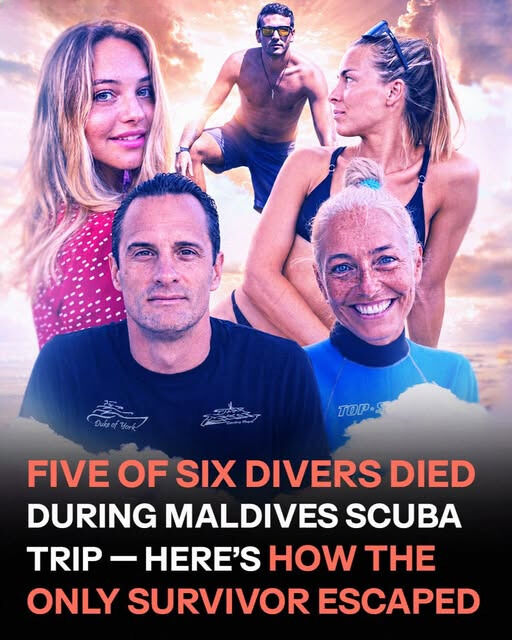
Five Italian divers who went missing during a deep-sea expedition in the Maldives were later discovered dead inside a submerged cave nearly 50 meters beneath the ocean surface. The discovery has triggered serious questions about whether the group exceeded safe recreational diving limits and entered conditions far more hazardous than anticipated.
The incident has since expanded in scope: a Maldivian military diver also died during the recovery operation, and authorities have launched an investigation into dive depth, equipment standards, and whether the expedition’s full plan was properly communicated to officials.
Maldives government spokesperson Mohamed Hussain Shareef has called it the most severe single diving disaster in the nation’s history.
The group had been traveling aboard the Duke of York, a 36-meter luxury liveaboard yacht that departed from Malé on May 10 for a week-long voyage. Twenty other guests remained onboard when the five divers entered the water that morning and never returned to the surface.
Investigators, officials, and diving experts are now working to reconstruct what may have occurred.
Did the Divers Go Beyond Legal Depth Limits?
The entrance to the cave where the divers were found lies at approximately 47 to 50 meters below sea level. In the Maldives, recreational diving is restricted to 30 meters, while anything beyond 40 meters requires advanced technical certification and specialized equipment.
Government spokesperson Mohamed Hussain Shareef told CNN that both recreational and commercial divers are legally prohibited from exceeding those limits. He noted:
“Sadly, this appears to have occurred much deeper, since even the cave entrance is close to 50 meters down.”
According to reports, Monica Montefalcone’s team held a scientific permit valid until the Sunday after the dive, allowing descents up to 50 meters across multiple atolls, including Vaavu, with the Duke of York listed as the assigned vessel.
Weather conditions were also a concern, as the Maldives Meteorological Service had issued a yellow alert for rough seas and strong winds on the day of the dive.
Attorney Orietta Stella, representing Italian tour operator Albatros Top Boat, stated that the group appeared to be using standard recreational diving equipment rather than specialized deep-diving gear.
She also clarified that Albatros did not own the Duke of York and did not employ its crew, who were locally contracted.
Who Were the Divers Who Never Returned?
The group was experienced, academically involved, and well-versed in marine research diving, making the outcome even more difficult to understand.
Professor Monica Montefalcone, an ecology researcher at the University of Genoa, was in the Maldives conducting a scientific study on climate change impacts on marine ecosystems. She was accompanied by her 20-year-old daughter, Giorgia Sommacal, a biomedical engineering student.
Marine conservation researcher Muriel Oddenino also joined the expedition.
Marine ecology graduate Federico Gualtieri, 31, completed the research team. His master’s thesis focused on Maldivian coral atolls.
The fifth diver, Gianluca Benedetti, worked as the group’s diving instructor and vessel operations manager. He had previously worked in banking and later transitioned fully into professional diving.
A sixth participant initially planned to dive but chose not to enter the water. The remaining passengers aboard the Duke of York later received psychological support from the Italian Red Cross.
Carlo Sommacal, Montefalcone’s husband and Giorgia’s father, described her as an extremely experienced diver with around 5,000 dives, who had survived the 2004 Indian Ocean tsunami while underwater off Kenya’s coast. He said:
“She would never have endangered our daughter or anyone else’s children.”
Greenpeace Italia also paid tribute to Montefalcone, highlighting her scientific knowledge and the passion she brought to ocean conservation.
What Experts Believe May Have Happened
No official cause has been confirmed, but diving specialists have outlined several possible contributing factors.
Claudio Micheletto, head of pulmonology at the University Hospital of Verona, suggested a potential malfunction or issue involving breathing gas supply systems.
He noted that oxygen toxicity at extreme depths can cause dizziness, confusion, pain, and loss of awareness, potentially preventing divers from returning safely.
Alfonso Bolognini, president of the Italian Society of Underwater and Hyperbaric Medicine, raised the possibility of panic playing a role. In deep cave environments, even slight panic can disturb sediment and drastically reduce visibility.
He emphasized he had no direct knowledge of the event but warned that “panic can lead to deadly mistakes.”
British cave diving expert John Volanthen, known for his role in the 2018 Thai cave rescue, pointed to nitrogen narcosis, a condition caused by breathing compressed air at depth that can impair judgment and cause disorientation.
He explained that as depth increases, narcosis can both trigger panic and make navigation back to the exit significantly more difficult, especially if disturbed silt blocks visibility.
Maldives National Defence Force advisor Shaff Naeem, who has completed more than 50 technical dives in the same cave, also suggested possible insufficient gas reserves combined with strong currents that may have severely reduced visibility.
Why the Rescue Operation Turned So Risky
Divers Alert Network Europe reports that the cave system reaches depths of around 70 meters and extends roughly 200 meters in length. Narrow passages, powerful currents, and total darkness make it extremely hazardous.
These were the exact conditions faced by every diver involved in the rescue effort.
Staff Sergeant Mohamed Mahudhee, 43, a senior diver in the Maldives National Defence Force, died on May 16 after suffering decompression sickness during recovery operations.
Shareef explained that Mahudhee was diving in a pair when his partner noticed signs of distress during ascent. The team immediately attempted rescue but found him unconscious underwater.
He was later honored with a military funeral in Malé, attended by hundreds including President Mohamed Muizzu. Shareef said:
“He was among the most experienced divers, which highlights how dangerous this operation was.”
The four missing Italian divers were eventually found on May 18 by a Divers Alert Network Europe team using advanced rebreathers and underwater scooters.
They were located together in the deepest part of the cave. One rescuer surfaced carrying a logbook containing a short handwritten note:
“WE FOUND ALL FOUR.”
What Authorities Are Investigating Now
The operating license of the Duke of York has been suspended while investigators review whether proper safety procedures were followed.
Italian tour operator Albatros Top Boat, through legal representatives, stated it was unaware the divers intended to exceed the Maldives’ 30-meter recreational limit and said it would not have approved such a dive.
Maldives officials confirmed a full investigation is underway into the circumstances surrounding the tragedy.
The University of Genoa later clarified that the dive was conducted privately and not as part of any official academic research program.
Authorities also revealed that Sommacal and Benedetti were not included in the approved research permit, and the cave itself was not listed in the submitted research documentation.
Italy’s Foreign Minister Antonio Tajani confirmed ongoing efforts to repatriate the victims. Both Maldivian and Italian governments remain in close contact, with President Muizzu expressing condolences to President Sergio Mattarella.
Shareef added that the incident deeply affected local communities due to the strong ties between the two nations, stating that everything would be thoroughly examined.
Still, many questions remain unresolved.