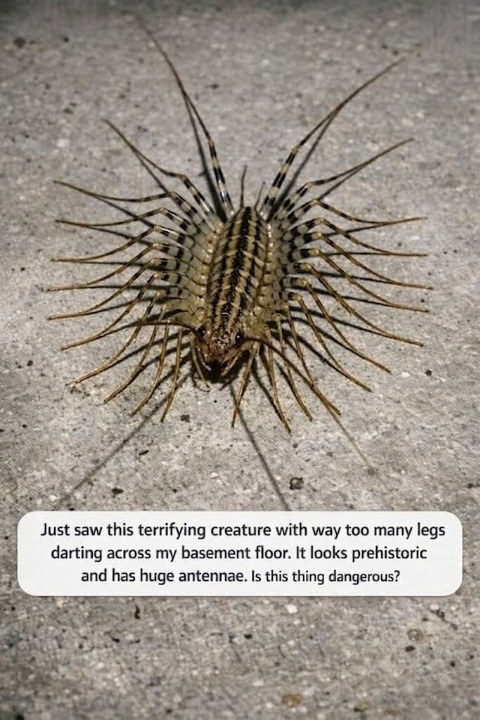
Finding a strange, fast-moving creature with dozens of legs racing across your basement floor is enough to make almost any homeowner panic. With its long body, rapid movements, and tangled-looking legs, the insect appears more like something escaped from a science fiction film than a normal household pest. The first reaction for most people is immediate disgust mixed with concern about whether the bizarre intruder could hurt children, pets, or anyone living in the home.
The unsettling creature lurking in dark corners is most likely a house centipede, scientifically known as Scutigera coleoptrata. This unusual arthropod has a pale yellow or grayish body that can grow up to about an inch and a half long, usually marked with darker stripes along its back. What makes it especially alarming is its fifteen pairs of incredibly long legs, which create the illusion of constant motion even when the creature pauses. Add in a pair of extra-long antennae that often stretch farther than the body itself, and the result is one of the most unsettling-looking insects commonly found inside homes. House centipedes are especially common in damp, quiet spaces such as basements, bathrooms, crawl spaces, laundry rooms, and storage areas.
The fear people feel when seeing a house centipede is understandable because the creature is built for speed. Its many legs move in synchronized waves that allow it to travel surprisingly fast, often disappearing across a wall or floor before someone even has time to react. These centipedes can climb vertical surfaces effortlessly, squeeze into tiny cracks, and navigate dark environments using their highly sensitive antennae. Although their appearance seems almost alien, these adaptations simply make them extremely efficient hunters.
One of the biggest concerns homeowners have is whether house centipedes are dangerous. Thankfully, despite their intimidating appearance, they are largely harmless to humans and pets. House centipedes do possess venom, but it is specifically designed to immobilize tiny insects rather than larger animals. Their mouthparts are relatively weak and rarely able to break human skin. In the uncommon event that a bite does occur, the result is usually mild redness or a slight stinging sensation similar to a bee sting, which normally fades quickly without medical treatment.
Pets are also generally safe around them. House centipedes avoid confrontation whenever possible and prefer escaping rather than defending themselves. Curious cats or dogs may chase one briefly, but bites involving pets are extremely rare. Most centipedes will dart into the nearest crack or dark hiding place long before a pet can catch them.
What surprises many people is that house centipedes are actually beneficial to have around. They are natural predators that feed on many of the insects homeowners truly do not want inside their houses. Their diet includes cockroaches, spiders, ants, silverfish, termites, moths, and even bed bugs. In many ways, house centipedes function as free pest control, quietly hunting other insects during the night while remaining hidden most of the time.
Their presence usually points to a specific environmental issue inside the home. House centipedes thrive in areas that provide moisture, darkness, and plenty of smaller insects to hunt. Basements often create the perfect environment because they tend to stay cool, humid, and undisturbed. If a home has frequent insect activity combined with damp conditions, centipedes are likely to appear because they have both shelter and food available.
For homeowners who simply cannot tolerate seeing them indoors, removal is relatively simple and does not require harsh chemicals. The easiest method is using a cup and a stiff piece of paper or cardboard. Carefully trap the centipede under the container, slide the paper underneath, and release it outside in a shaded, damp area away from the house. Since the creature is far more frightened of you than you are of it, it will usually try to flee immediately rather than resist.
Preventing future centipede encounters involves changing the conditions that attract them. Using a dehumidifier in damp basements helps eliminate the moisture they need to survive. Repairing leaks, improving ventilation, and sealing cracks around doors, windows, and pipes can also reduce entry points. Keeping storage spaces organized and reducing clutter removes dark hiding places while also lowering the insect populations that centipedes hunt for food.
Although their appearance can feel genuinely horrifying at first glance, house centipedes are not dangerous monsters invading your home. They are simply highly specialized predators performing an important ecological role. Once the initial shock fades, many homeowners eventually realize that these creepy-looking creatures are actually helping keep far more troublesome pests under control behind the scenes.