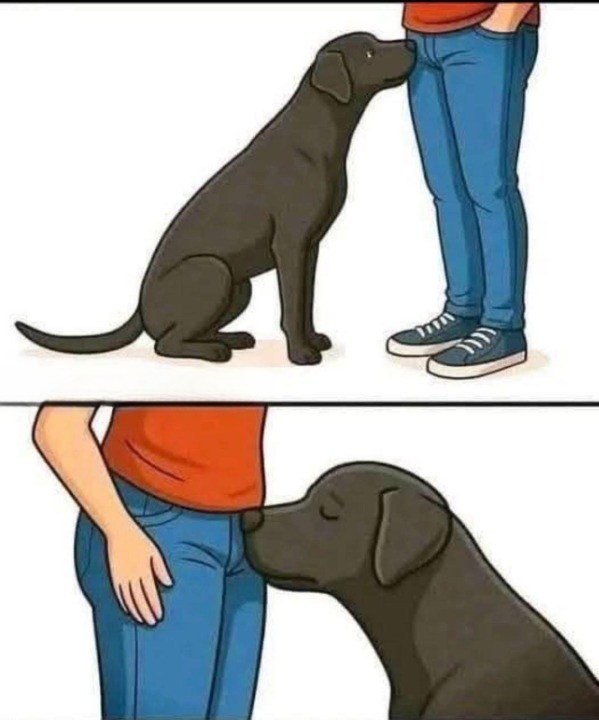
The deeply advanced sensory world of domestic dogs operates on a level of smell that human beings can barely begin to imagine. While people mainly rely on speech, facial expressions, and visual observation to understand one another, dogs interpret the world almost entirely through scent. Every person, object, and environment carries layers of invisible chemical information that dogs instinctively analyze in extraordinary detail. To a canine, smell functions as a complete communication system capable of revealing emotional states, physical health, identity, stress levels, and countless other biological signals. This overwhelming dependence on scent often leads dogs to display behaviors that humans find awkward or embarrassing, particularly when they insist on sniffing a person’s groin area. Although many owners assume the behavior is rude, unhygienic, or poorly trained, animal behavior specialists explain that it is actually a completely normal and deeply instinctive form of canine communication.
Understanding this common behavior begins with examining canine biology and the powerful scent-processing system dogs possess. Inside a dog’s nasal cavity is a specialized sensory structure called the vomeronasal organ, also known as Jacobson’s organ. This remarkable organ is designed specifically to detect pheromones, which are chemical compounds naturally released by living creatures to communicate biological information. Humans also emit these chemical signals through apocrine sweat glands, which are concentrated primarily in areas such as the underarms and groin.
Unlike regular sweat glands that mainly regulate body temperature, apocrine glands release a more chemically complex scent profile containing information about a person’s emotional condition, hormonal state, health, diet, and identity. To dogs, these scents function almost like a detailed biological fingerprint. When a dog approaches someone and immediately targets the pelvic region for investigation, the animal is not behaving inappropriately out of spite or mischief. Instead, it is instinctively gathering information in the most efficient way possible.
Since dogs are physically unable to reach most people’s underarms due to height differences, the groin area becomes the easiest location for accessing these concentrated scent signals. From the dog’s perspective, the interaction is simply a highly detailed greeting and assessment process.
Veterinary experts and canine behaviorists often compare this behavior to the human equivalent of shaking hands or introducing oneself during a conversation. Dogs evolved over thousands of years to evaluate other animals, environments, and humans primarily through scent detection. Smelling allows them to determine whether someone feels nervous, calm, healthy, frightened, familiar, or unfamiliar. For canines, scent serves as an essential social tool rather than an invasion of personal space.
Animal behavior professionals emphasize that expecting a dog to completely ignore strong pheromone signals would be similar to expecting a human to walk through life blindfolded. Smell is the dominant sense through which dogs understand reality.
Even though the behavior is biologically normal, many owners understandably feel uncomfortable when their dog begins intensely sniffing guests in public situations. Fortunately, experts explain that dogs can be gently redirected without punishment or fear-based correction. Because dogs are highly responsive to positive reinforcement and obedience training, owners can teach alternative greeting behaviors through consistency and calm guidance.
Rather than reacting with panic, yelling, or physical punishment, which may increase confusion or anxiety, trainers recommend redirecting the dog’s focus with commands such as sit, stay, or come. Rewarding the redirected behavior with treats, praise, or affection helps reinforce more socially acceptable greetings while still respecting the animal’s natural instincts.
Modern animal behavior advocates believe that understanding the science behind canine communication helps eliminate unnecessary embarrassment and frustration between humans and their pets. The more people understand how dogs naturally process the world, the easier it becomes to build stronger relationships rooted in patience, empathy, and trust.
The next time a friendly dog confidently approaches someone and begins investigating their clothing, experts encourage people not to immediately interpret the behavior as offensive or strange. In reality, the dog is simply engaging in one of the oldest and most instinctive forms of communication in the animal kingdom. From the canine perspective, it is not an awkward interaction at all. It is simply their way of learning who you are and welcoming you into their sensory world.