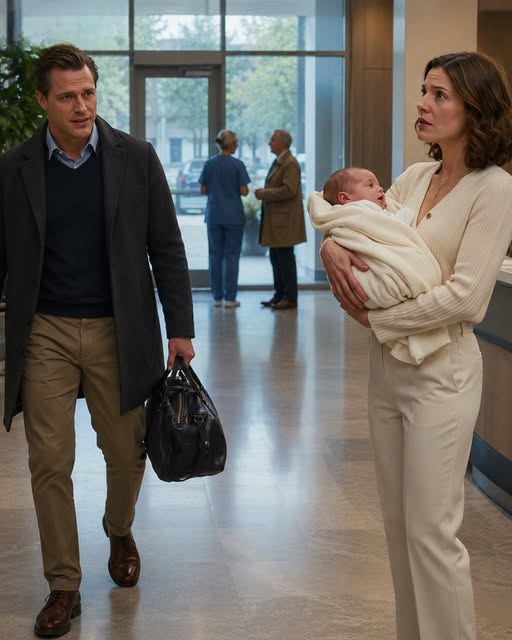
“I need you to stay calm, Nat. The doctors are with him. You don’t need me there.”
That was the last thing my husband said before he hung up and went back to his ski weekend in Whistler while our eleven-month-old son lay limp against my shoulder with a 104-degree fever and a paper wristband around his tiny wrist at Seattle Children’s.
There are marital moments that arrive with noise—slamming doors, shouted words, broken plates—and then there are the quiet ones that change everything without raising their voices. A sentence. A pause. A tone so flat and certain it tells you more than an argument ever could.
I stood in the pediatric emergency room holding Liam, my diaper bag sliding off one shoulder, and stared at my dark phone screen. I didn’t cry right away. I didn’t call back. I just tucked the phone into my coat pocket, shifted Liam higher against my chest, and felt something inside me go still.
Not cold. Not numb. Clear.
My name is Natalie Parker. I was twenty-nine that winter, married to Marcus Hale for a little over three years. From the outside, we looked like one of those couples who had figured it out early. Good jobs. Weekend brunches. A baby at the right time. The photographs certainly said so. Pictures are obedient. They tell the version of the story people know how to pose for. Real life is made of smaller things—the way someone responds when you’re too tired to speak in complete sentences, the way they treat inconvenience, the way they talk to you when no one else is in the room.
The first year of marriage wasn’t obviously bad. If it had been, I might have trusted myself sooner. Instead, it was marked by a thousand tiny redistributions of labor so gradual I hardly noticed them happening. Marcus left dishes in the sink because he was “running late.” He dropped his dry cleaning ticket on the counter because I was “better at remembering stuff.” His gym clothes fermented in the hamper until the smell forced me to do a load I hadn’t planned on. If he picked up groceries, he forgot at least one crucial thing and returned with a sheepish grin.
“You’re just better at this home stuff than I am,” he would say.
It sounded like praise if you didn’t examine it too closely.
Then I got pregnant, and the balance tipped from uneven to unmistakable. I was sick for months. My ankles swelled. My lower back ached. Marcus was attentive when other people were looking—resting a hand on my shoulder at dinners, calling me “our MVP” in front of friends. In private, he became exacting. Mildly inconvenienced. Always just plausible enough that I felt foolish reacting too strongly. If the apartment wasn’t spotless when he came home, he noticed. Not with yelling. With inspection.
When Liam was born, Marcus looked genuinely moved at the hospital. Fatherhood suited him beautifully there. At home, it suited him only in curated portions. He loved holding Liam when Liam was clean, sleepy, and inclined to stare at ceiling fans. He liked wheeling the stroller through downtown Kirkland on Saturday mornings where other people could smile at him. But the actual weight of caring for an infant—night wakings, blowouts, pediatrician appointments, the panic over fevers—settled almost entirely on me. Marcus called what he did “helping.” That word lodged in me like a splinter. Helping implied the work belonged to me in the first place.
In early December, Liam got sick. It started with a runny nose and low-grade fever, but he wasn’t himself. He was clingy, quiet, tugging at one ear, refusing naps. I told Marcus all of this. Then he came home and announced he and four guys from the office were going to Whistler for a long ski weekend.
“This weekend?” I asked.
He nodded. “Trevor found a package. Friday night out, back Monday.”
“Marcus, Liam’s been sick all week.”
“He has a cold.”
“He has more than a cold.”
He set down his fork and leaned back like a man patiently entering a negotiation he considered unnecessary. “Natalie, kids get sick. He’ll be fine.”
“The point is I’m asking you not to leave town when our baby might need a doctor.”
He exhaled through his nose. “I already paid my share. It’s nonrefundable. And I haven’t gone anywhere in months.”
“You went to Palm Springs in September for the conference.”
“That was work.”
“You golf every other Saturday.”
“So now golf counts as a trip?”
“No,” I said. “It counts as leaving.”
Then he said the thing I can still hear in his exact tone: “You’re home all day. Managing one sick baby for a weekend is not an emergency.”
He said it without meanness. That was what made it so terrible. There are comments that bruise because they are sharp, and then there are comments that bruise because they reveal, with perfect accidental honesty, the hierarchy inside someone’s mind. You’re home all day. As if caring for an infant were decorative. As if my body, my time, my exhaustion had no weight because they were not invoiced.
I didn’t sleep much that night. Liam’s temperature hit 102.1 by morning. He didn’t want breakfast. He rested his head on my shoulder while I stood at the counter trying to drink coffee one-handed. Marcus packed in the cheerful, efficient way of someone leaving for leisure while assuming the domestic machinery behind him would continue uninterrupted.
“Please don’t go,” I said.
He came over and pressed the back of his fingers to Liam’s forehead like a man testing bathwater. “He’s warm. If it gets worse, take him in.”
“If it gets worse, I shouldn’t be doing that alone.”
He straightened, already irritated. “Natalie. I can’t cancel on everyone at the last second.”
I shifted Liam higher on my hip and said, very quietly, “You’re choosing a ski trip over your son.”
He stiffened. “That is not fair.” It is fascinating what people call unfair when they are being accurately described. He kissed the top of Liam’s head, grabbed his bag, and left. I stood at the door and watched him jog through the drizzle to Trevor’s car. He never once looked back.
By noon Liam’s fever was over 103. By two, after he refused even a few ounces from his bottle and made a soft, exhausted moaning sound, the pediatrician’s after-hours nurse told me to take him straight to Seattle Children’s ER. I moved fast—diaper bag, insurance card, extra onesie, blanket. Halfway down 405, I called Marcus. He picked up on the fourth ring. I could hear wind, men shouting, someone laughing.
“What’s up?” he said.
“What’s up is his fever is 104.1 and I’m taking him to Seattle Children’s.”
A pause. “Okay. Keep me posted.”
“Marcus, I need you to come home.”
“Natalie, by the time I get out of here, get back to Vancouver, get on a flight, it’ll be late tonight.”
“So what exactly would that change?”
For one wild second I thought I had misheard him. “He’s our son.”
“I know he’s our son.” His voice had shifted into that calm, managerial register he used for explaining basic facts to people he considered overly emotional. “He’s with the doctors now. Just stay calm, okay?”
Something in me detached right then—not from the marriage in some dramatic sense, but from the last stubborn illusion I’d been protecting. The illusion that if I found the exact right words, Marcus would suddenly understand. He understood. He simply didn’t care enough. I hung up without saying goodbye.
The parking garage at Seattle Children’s was almost full. Inside, the emergency department was bright, overheated, and full of that compressed public tenderness you only ever see in pediatric spaces. Because Liam was under one and running such a high fever, they took us back almost immediately. The triage nurse had kind eyes and pink scrub shoes. “You did the right thing bringing him in,” she said. That sentence nearly undid me. Not because it was extraordinary. Because I had spent so long living beside someone who made me feel as though every instinct required defense that simple validation felt like mercy.
Liam had a significant middle ear infection. They wanted to observe him overnight after fluids and the first dose of antibiotics. Overnight meant this was not me overreacting. Overnight meant that while Marcus was clipping into skis in British Columbia, his son was being admitted to a children’s hospital.
The next morning, Liam looked better in the way children often do—suddenly, almost rudely, as if the night before had not split you open. They discharged us by noon. I drove home with the strange, hollow adrenaline that follows fear. Marcus came home Sunday evening. Windburned. Expensive jacket. He looked healthy, rested, and mildly guilty in the way men do when they know they’ve done something socially questionable but haven’t yet accepted that it might also have been morally serious.
“How is he?” he asked.
“He was admitted overnight.”
He frowned. “For an ear infection?”
“And dehydration.”
“They kept him overnight for that?”
I looked at him for a long time. He genuinely did not understand what he was looking at—the discharge papers on the coffee table, the hospital bracelet I had forgotten to take off my own wrist, the fact that I had spent the night in a chair beside our son while he drank whiskey by a fireplace somewhere north of Vancouver.
“Well,” he said finally, “the important thing is he’s okay.” Then, after a beat, as if offering reassurance to a skittish employee: “See? They took care of it.”
I think many marriages end long before the paperwork does. They end in the moment one person sees that the other is committed not to mutual reality but to the version of events that protects their self-image.
I said, “I should not have had to do that alone.” He looked at me with puzzlement. Not shame. Not remorse. Puzzlement. As if my hurt had arrived from nowhere. He opened his mouth, probably to say that he couldn’t have gotten back in time anyway, or that Liam was okay now, or that I was tired and emotional. I held up a hand. “Not tonight.”
That night, after Marcus went to bed, I sat at the dining table with a spiral notebook and started writing. Not because I was certain I would leave. Not yet. Because I needed to see it. Dates. Incidents. Words. Patterns. I wrote until my wrist hurt. Then I took screenshots of texts, backed up emails, photographed the discharge paperwork. And for the first time in my adult life, I began making a plan that did not assume my marriage would improve if I just became kinder, calmer, more patient, more grateful.
I filed for separation. The final parenting plan took months, not because the issues were conceptually complex but because Marcus needed time to accept that fairness would not be defined by his preferences. In the end, primary residential time with me, every other weekend with him. He signed not because he was transformed but because by then he understood that court was unlikely to reward performance over documented caregiving.
We moved to a smaller townhome. The place had beige carpet and a narrow kitchen, but the morning light in Liam’s room was beautiful, and for the first time in years the emotional weather inside my home matched what was actually happening. If the sink held dishes, it was because I had used them. If the laundry sat unfolded, no one turned it into a referendum on my competence.
I returned to my agency three days a week. My old rhythm returned in pieces—presentation decks, brand audits, client feedback. There was relief in being measured by work I made rather than sacrifices no one could see. Liam thrived. He grew out of the clingy phase and into toddlerhood with comic seriousness. He learned to say “Mama” with intent. He learned that pancakes are preferable to almost every other food except blackberries.
One night, nearly a year after the hospital weekend, I stood in Liam’s doorway while he slept. His cheeks were pink, one hand tucked under his face. I remembered the chair in Seattle Children’s, the plastic rail of the crib beneath my forehead, the promise I made in the dim light while his fever finally broke.
I will never forget this.
At the time, I thought the promise was about hurt. About betrayal. About never letting Marcus revise history. But standing there a year later, I understood it differently. The promise was not only never forget what he did. It was never forget what I learned. Never forget how quickly my mind had sharpened once I stopped using it to defend the indefensible. Never forget that fear is information. Never forget that love without reliability is just longing in nice clothes. Never forget that homes are made or broken in quiet moments no one photographs.
Sometimes a crisis does not create the truth of a relationship. It reveals it. Sometimes the worst thing a person does to you is not explosive enough for outsiders to name quickly, but clear enough that once you see it, you cannot ethically unsee it. Sometimes the end begins not with a scream but with a sentence spoken from a ski resort while your baby burns with fever in your arms.
And sometimes that is enough.