For years, I kept showing up for Arthur, even when everyone else had given up on him.
He had a reputation on our street. Difficult. Cold. The kind of man people avoided if they could. Conversations with him rarely lasted more than a few seconds before turning sharp, and most neighbors stopped trying altogether.
But I couldn’t ignore what I saw behind all that.
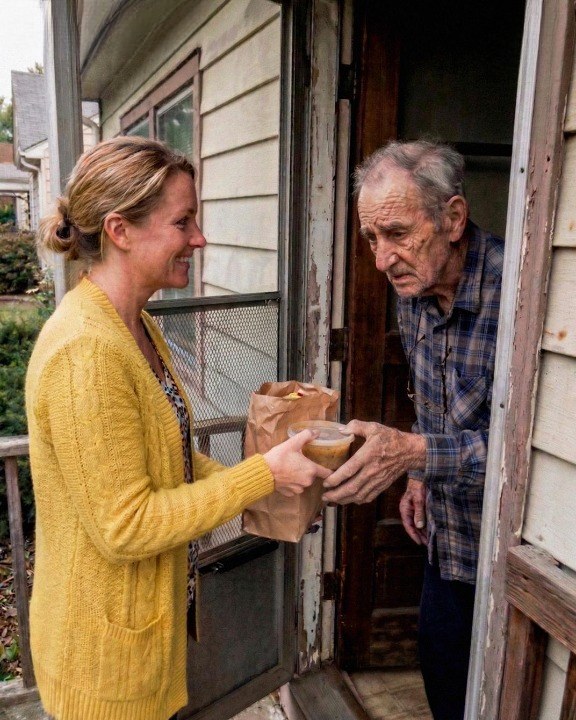
At the time, I was raising seven kids on my own, juggling multiple jobs, stretching every dollar and every ounce of energy I had just to keep things going. Still, every evening, I made an extra plate of food and walked it over to Arthur’s house.
People thought I was wasting my time.
Some even told me I was being naive.
But I kept going anyway.
Because beneath his harsh words and distant behavior, I saw something else. I saw a man who had been left alone for far too long.
At first, he barely acknowledged me.
He would take the plate without a thank you, sometimes muttering something under his breath, sometimes closing the door before I could say a word. There were days when he didn’t even open it at all.
But I didn’t stop.
I told myself it wasn’t about how he responded. It was about making sure someone showed up for him.
Over time, things began to shift in small, almost unnoticeable ways.
He started leaving the plate outside for me instead of making me knock twice. Once, he even said “fine” when I asked how he was doing. It wasn’t much, but for Arthur, it was something.
One winter afternoon, everything changed a little more.
I found him outside, struggling to get up after slipping on a patch of ice. He looked frustrated, embarrassed, like he hated needing help. I didn’t say anything. I just helped him to his feet and made sure he got inside safely.
Before I left, he looked at me in a way he never had before.
“Why do you bother?” he asked quietly. “You’ve got your own problems. Why keep coming here?”
I didn’t overthink it.
“Because no one deserves to be alone,” I told him.
He didn’t respond right away.
But after that day, something softened.
He never became warm or easy. He never turned into the kind of person who welcomed company with a smile. But he stopped pushing me away quite so hard. He let me in, just enough for me to see the weight he carried.
When he passed away at 80, I didn’t expect anything more than a quiet goodbye.
I thought I’d attend the service, maybe leave flowers, and that would be it.
So when I received an invitation to the reading of his will, I was confused.
Even more so when I learned I’d be sitting there alongside his three children—people he hadn’t spoken to in years.
The room felt tense from the start.
They barely looked at me, clearly wondering why I was even there.
Honestly, I was wondering the same thing.
Then the lawyer began.
Instead of reading everything straight from paper, he played a recorded message.
Arthur’s voice filled the room.
It was strange hearing it like that. Calm. Clear. Almost reflective.
He spoke about his life. About the distance that had grown between him and his children. About the choices he had made and the regrets he never quite faced.
And then… he spoke about me.
He said he had noticed me long before I ever brought him that first plate of food.
He had been watching.
Waiting.
Testing whether I would give up like everyone else had.
But I didn’t.
And because I didn’t, something changed for him.
He said I reminded him of what he had lost—and what he had pushed away.
When the lawyer continued reading, the room went completely silent.
Arthur had left me his house.
And the remainder of his savings.
I could feel the shock settle over everyone at once.
His children were stunned. Hurt. Confused.
I didn’t even know what to feel.
It wasn’t something I had ever expected. It wasn’t something I had ever worked toward.
It just… was.
In the days that followed, his children approached me.
They wanted to sell the house. Split everything. Move on.
It would have been easier to agree.
But something in me wouldn’t let me.
That house had been filled with silence for too long.
So I made a different decision.
I kept it.
And slowly, I turned it into something new.
A place where people could come together. Where no one would feel forgotten or pushed aside. Where meals were shared, conversations happened, and laughter replaced the quiet that used to fill every room.
It didn’t happen overnight.
But little by little, it grew.
Neighbors started coming by. Then more people. Then families who needed a place to sit, to talk, to feel like they belonged somewhere.
Even Arthur’s children came back.
At first, just to see. Then to stay a little longer. Then to help.
Over time, something healed between them, too.
In the end, those small acts that once seemed meaningless didn’t just change one life.
They changed many.
Arthur never said thank you the way most people would.
But in his own way, he made sure it was understood.
And I learned something I’ll never forget.
Kindness doesn’t always look like it’s working.
But sometimes, it’s doing more than we could ever imagine.