When my late husband’s best friend asked me to marry him, I truly believed I had already survived the hardest parts of grief, so I said yes. But on our wedding night, standing in front of an old safe while his hands trembled, my new husband said something that made me question everything I thought I knew about love, loyalty, and second chances.
I’m 41 now, and there are still days when I can’t quite believe this is my life.
For twenty years, I was Peter’s wife—not in some perfect, storybook way, but in the real, imperfect, deeply meaningful way that matters most. We shared a four-bedroom house with creaky floors, a porch that always needed repairs, and two kids who filled every space with noise, chaos, and love.
My son is now 19, studying engineering out west. My daughter just turned 21 and chose a college on the opposite coast, probably just to prove she could.
The house feels wrong without them… and without Peter. It’s too quiet, almost like it’s holding its breath.
Peter used to call our life “ordinary,” and he meant it as the greatest compliment. Saturday soccer games. Burned dinners we laughed over while ordering pizza. Small arguments about chores.
He’d try to fix things himself even when we both knew he’d only make them worse, and I’d pretend to be annoyed while secretly enjoying watching him struggle at the kitchen sink.
He wasn’t perfect. He drove me crazy sometimes. But he was steady, kind, and he made me feel safe in a way I didn’t fully understand until it was gone.
Six years ago, a drunk driver ran a red light and took him from us. I remember the police officer at my door and collapsing onto the porch, unable to hold myself together.
The weeks that followed are mostly a blur—just fragments.
My daughter crying behind a locked bathroom door. My son shutting down completely. Me standing in the kitchen at two in the morning, staring at Peter’s coffee mug still sitting where he left it.
And through all of that, there was Daniel.
He wasn’t just Peter’s friend—they were like brothers. They had grown up close, gone through college together, taken road trips with barely any money.
Daniel had his own struggles. A failed marriage, a young daughter, and the challenge of trying to be a good father despite everything. But he never complained. Never blamed anyone. That was something I always respected.
After Peter died, Daniel didn’t ask what I needed—he just showed up. He fixed things around the house, brought groceries, sat quietly with my son while he worked through his anger.
He never made it about himself.
Months later, I told him he didn’t have to keep doing all that.
“I know,” he said simply. “But Pete would’ve done the same for me.”
There was no hidden intention. Just loyalty.
The feelings didn’t arrive suddenly. They grew slowly, almost unnoticed.
Three years after Peter’s death, my children were finding their way again, and I was starting to feel like a person instead of just someone defined by loss. Daniel had stepped back, giving me space.
Then one night, my sink started leaking, and without thinking, I called him.
He showed up in sweatpants and an old T-shirt, fixing things like he always had. We joked, we laughed—and something shifted.
It wasn’t dramatic. No big moment. Just a quiet realization that I didn’t feel alone anymore.
Over time, we fell into a rhythm—coffee on Sundays, movies on Fridays, long conversations that didn’t need a purpose.
My daughter noticed before I did.
“Mom, he’s in love with you,” she said one day.
I denied it at first. But deep down, I knew.
And when Daniel finally confessed his feelings, sitting beside me as the sun set, I realized I felt the same.
“I love you,” he said quietly, almost like he was confessing something wrong.
“It’s not wrong,” I told him. “I feel it too.”
We took our time. We made sure it wasn’t just grief or loneliness.
When we finally shared the truth with others, my children supported us. Even Peter’s mother told me I wasn’t betraying him—that I was simply continuing to live.
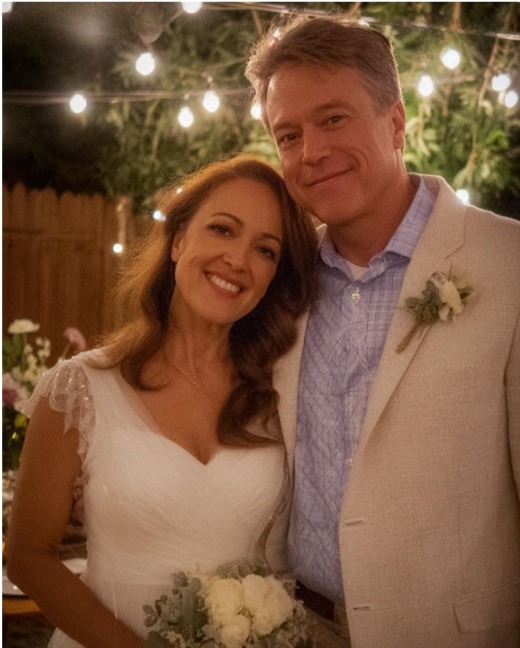
So we got engaged. Then married in a small backyard ceremony surrounded by people who truly cared.
That night, when we returned home, I thought I was stepping into a new chapter.
But instead, I walked into something I never expected.
Daniel stood in front of the safe, his hands shaking.
“There’s something you need to see,” he said.
Inside was an old phone.
On it… messages between him and Peter.
Messages from years before Peter died.
At first, they were ordinary—jokes, plans, everyday conversations.
Then one message stood out.
Daniel had written about how much he admired what Peter and I had.
And Peter responded firmly:
“Don’t go there. Promise me you’ll never try anything with her.”
I felt the air leave my lungs.
Daniel explained everything—how he had been going through his divorce, how he had spoken without thinking, how he had never intended anything back then.
He was terrified.
Terrified that he had somehow broken that promise.
Terrified that he had taken advantage of my grief.
“Tell me the truth,” he said. “Do you think I used you?”
I looked at him—the man who had supported me without ever asking for anything, who had waited until I was ready, who was now willing to walk away on our wedding night if it meant protecting me.
“Do you love me?” I asked.
“Yes,” he said immediately.
I held his face in my hands.
“You didn’t break anything,” I told him. “Life changed. We changed. And we found each other after everything.”
Peter hadn’t chosen this. None of us had.
But if he could see us, I believe he would understand.
Daniel wasn’t a betrayal.
He was someone who stayed. Someone who cared. Someone who never stopped being kind.
We kissed that night—not out of excitement, but out of something deeper.
Something real.
Two months later, I still wake up beside him knowing I made the right choice.
Not because it was simple—but because it was honest.
Peter will always be part of my life. He gave me years of love, our children, and a foundation that will never disappear.
But he isn’t the end of my story.
Daniel is what came next.
And maybe that’s the truth about grief and love—
You don’t replace what you lost.
You carry it with you…
and still find a way to keep living.