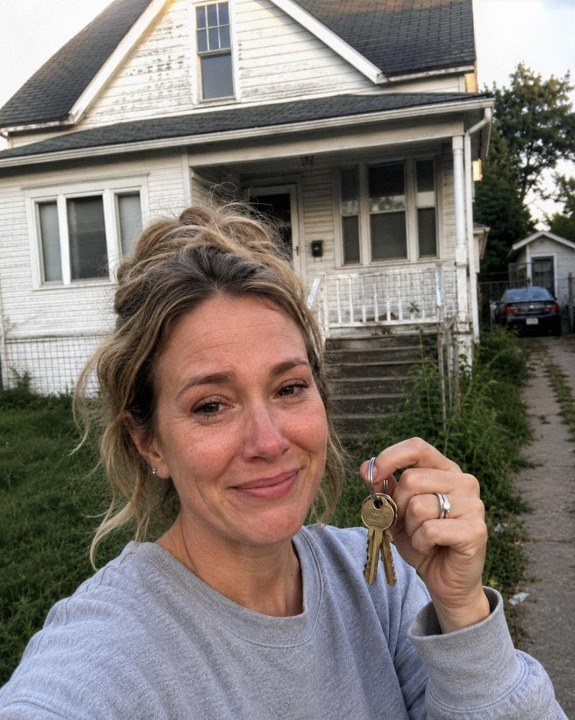
The first thing I noticed after stepping back into my childhood home was the smell.
Not dust.
Not mold.
Memory.
The house still carried traces of old pine cleaner, faded wallpaper, and the faint scent of smoke from winters my father spent feeding logs into the fireplace while my brother and I slept upstairs. Standing alone in the silent entryway, I felt time fold in on itself so suddenly that for one painful second, I expected to hear my mother humming in the kitchen again.
Instead, the house stood empty.
Cold.
Forgotten.
Twenty years earlier, I watched strangers carry our furniture onto the lawn while my mother cried in the driveway and my father stared silently at the ground like a man waiting for punishment. Nobody explained much to me back then. I only knew we were losing everything.
And somehow, everyone blamed my father.
After that day, my mother rarely spoke about the house again. My father became quieter every year until his death five winters ago. Whatever happened inside these walls buried itself so deeply inside our family that nobody ever dared dig it back up.
But I never forgot.
That was why, when the old property appeared at a county auction, I bought it without hesitation.
It took me twelve years of saving, working overtime, and rebuilding my finances to afford it. Friends told me it was emotional nonsense to spend so much money on a painful memory.
Maybe they were right.
But when the keys landed in my hand, it felt like reclaiming something stolen from me long ago.
The first evening inside the house, rain tapped softly against the windows while I unpacked boxes by myself. The electricity worked only in half the rooms, and the plumbing groaned like an old man waking from sleep.
Still, I felt strangely peaceful.
Until I noticed the wall behind the pantry.
At first glance, it looked normal.
But something about it bothered me.
The paint texture didn’t fully match the surrounding walls. The floorboards beneath it looked newer. When I knocked against the surface, the sound changed instantly. Hollow.
My pulse quickened.
I grabbed a flashlight and examined the edges more carefully. Hidden behind old shelving, someone had clearly sealed off part of the original floor plan years ago.
Right as I reached for a hammer, my phone rang.
Mom.
I smiled automatically before answering.
But the moment I heard her voice, the smile disappeared.
She was crying.
Not softly either.
Panicked.
“Astrid,” she whispered urgently. “Please tell me you haven’t opened it.”
Cold spread through my chest.
“Opened what?”
“The room,” she said shakily. “The room your father sealed off.”
I turned slowly toward the hidden wall.
For several seconds, neither of us spoke.
Then I quietly asked the question that had lived inside me for twenty years.
“What’s in there?”
My mother inhaled sharply like she regretted calling at all.
“Some things are better buried,” she whispered.
That only made me more certain I needed the truth.
After we hung up, I stood staring at the wall for nearly ten minutes before finally grabbing the hammer.
The first strike sounded unnaturally loud inside the empty house.
Dust exploded into the air.
The second hit cracked through the drywall completely.
By the time I pulled away enough boards to crawl through, my hands were shaking.
The hidden room was small and windowless.
Not some horrifying chamber like my imagination briefly feared.
Just storage.
But the moment my flashlight swept across the stacks of boxes, I realized this room contained something far heavier than old furniture.
Secrets.
Dozens of cardboard boxes lined the walls. Filing cabinets sat beneath dusty sheets. Papers covered nearly every surface.
And all of it belonged to my father.
I opened the nearest box first.
Inside were unpaid mortgage notices, overdue bank statements, foreclosure warnings, and handwritten letters folded so many times the edges were nearly falling apart.
My father’s handwriting covered every page.
At first, none of it made sense.
Then I found the letters addressed to Uncle Tom.
And suddenly, the entire story shattered.
Growing up, I always knew my uncle struggled financially. He bounced between failed businesses, bad investments, and constant emergencies. But according to family stories, my father supposedly ruined us through bad money management and stubborn pride.
That wasn’t true.
The letters proved everything.
Over and over, my father drained our savings trying to rescue Tom from disaster.
One letter begged him to repay a loan before the bank repossessed our home.
Another revealed my father secretly refinanced the house twice to cover Tom’s gambling debts.
The final letter nearly destroyed me.
Tom,
I cannot save you again.
Astrid and Asher are starting to notice things. Claire is terrified. We are going to lose the house if you don’t repay even part of what I gave you.
Please.
I’m begging you now as your brother.
There was never any response attached.
Only silence.
I sat on the dusty floor crying harder than I had since my father’s funeral.
All those years, I believed he failed us.
But the truth was so much sadder.
He sacrificed us.
Not because he didn’t love his family.
Because he loved them too much and believed he could somehow save everyone at once.
The next morning, I drove directly to my mother’s apartment carrying a box of letters.
The moment she saw them, her face crumpled.
“You opened it,” she whispered.
“You let me hate him.”
Tears filled her eyes instantly.
“He made me promise,” she said quietly. “Your father didn’t want you children carrying bitterness toward your uncle. He thought protecting the family mattered more than protecting himself.”
I couldn’t understand that kind of forgiveness.
Maybe I still can’t.
A week later, my brother Asher and I confronted Uncle Tom during a family barbecue.
At first, he denied everything.
Then I placed the letters in front of him.
The color drained from his face so quickly it frightened me.
Nobody spoke while Asher read portions aloud.
The begging.
The desperation.
The warnings.
The truth.
Tom eventually admitted my father spent years rescuing him financially while quietly hiding the damage from everyone else. Even after losing the house, my father never exposed him publicly.
Not once.
Because loyalty mattered more to him than pride.
That realization changed everything I thought I knew about my father.
He wasn’t weak.
He wasn’t careless.
He was flawed. Loving. Self destructive in the way some deeply loyal people become when they cannot stop trying to save those they love.
And for the first time in my life, I felt proud of him again.
A month later, I returned to the hidden room with fresh paint, new lighting, and open windows.
I tore down the remaining boards completely and let sunlight flood the space for the first time in decades.
The room no longer felt haunted after that.
Neither did the house.
Because sometimes healing doesn’t come from hiding painful truths behind sealed walls.
Sometimes it comes from finally opening them and allowing the light to reach everything buried inside.