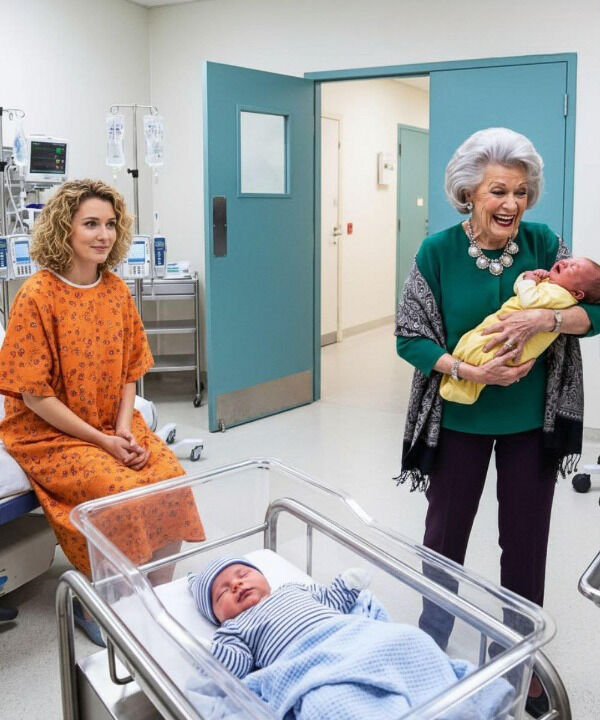
The expression on Andrew’s face is something I’ll never forget. It was the exact moment he realized that the woman he thought he knew—the one he believed he had completely figured out—was someone entirely different.
Chief Ruiz spoke into his radio, coordinating with the rest of the security team.
“We need medical staff to document the judge’s injuries,” he said. “And get someone from legal down here right away. This is an assault on a federal official.”
Margaret was still holding Noah, and my son was still crying. Every second he remained in her arms felt unbearable.
“Give me my son,” I said quietly.
One of the officers stepped in, carefully but firmly taking Noah from her and placing him back in my arms. The moment I held him against my chest again, some of the tension left my body. He calmed quickly, as if he knew he was safe again.
Margaret’s face had gone pale beneath her makeup.
“This is ridiculous,” she said, her voice unsteady. “Andrew, tell them this is a misunderstanding. Tell them I was only trying to help.”
Andrew looked overwhelmed, stuck between his mother and what had just happened.
“Mom… you hit her,” he said weakly. “I saw the blood.”
“She was hysterical!” Margaret snapped. “She was going to hurt the baby!”
Chief Ruiz pulled out his notebook.
“Ma’am, you need to stop talking. Anything you say can be used against you in court.”
That finally seemed to break through her confidence. Her eyes widened as she realized this wasn’t something she could talk her way out of or fix with influence.
A nurse appeared in the doorway, concerned.
“Judge Carter, we need to examine you and document your injuries,” she said gently. “We also need to check your surgical site to make sure there’s no damage.”
The adrenaline that had kept me going began to fade, replaced by sharp waves of pain that made it hard to breathe.
“Noah needs to be checked too,” I said. “She handled him roughly. I want to be sure he’s okay.”
Another nurse took Noah carefully and examined him. I watched closely until she gave me a small reassuring nod. Only then did my heart settle.
The Conversation That Changed Everything
While the nurses documented my injuries—the split lip, the bruising already forming, the strain on my incision—Andrew stood off to the side, looking like everything around him had collapsed.
“Why didn’t you tell me she was planning this?” I asked once the nurses stepped away.
He ran a hand through his hair, avoiding my eyes.
“She mentioned it a few weeks ago,” he admitted. “She said Karen couldn’t have children. She asked if we’d consider helping after the babies were born.”
“And you said?”
“I said I’d think about it.”
The words sat heavy in the air.
“You said you’d think about giving away one of our children,” I repeated slowly. “Without telling me.”
“I didn’t think she’d actually do this!” he said. “I thought we’d talk about it later, once you recovered.”
“Talk about giving away our son.”
“He’s my nephew too! Karen’s my sister. Family helps family!”
I looked at him carefully, truly seeing him for the first time.
“Your mother just assaulted me hours after surgery,” I said. “She tried to take our newborn. And you’re still defending her.”
“I’m not defending what she did,” he said quickly. “But she’s still my mother. And you never told her you were a judge. If she had known—”
“She wouldn’t have tried to take my child if she knew I had power?” I cut in. “So it’s only wrong when the person isn’t powerless?”
He had no answer.
Chief Ruiz stepped closer.
“Judge Carter, the district attorney’s office has been notified. They’ll take your statement once you’re cleared medically.”
I nodded. “Thank you.”
He hesitated for a moment.
“Your Honor… I’ve been doing this for fifteen years. I’ve never seen anything like this.”
“Neither have I,” I said quietly.
The Months That Followed
Margaret was arrested and charged with assault, attempted kidnapping, and filing a false report. Because of my position and the location, the charges carried heavier penalties.
Her lawyer tried to negotiate. I refused.
The case went to trial four months later. I stepped away from my duties briefly to testify, explaining everything clearly and without emotion.
The jury deliberated for less than three hours.
Guilty on all counts.
She was sentenced to seven years in federal prison. No early release. No leniency.
Andrew unraveled during the trial, insisting his mother hadn’t meant harm and that family should forgive.
Two weeks after the sentencing, I filed for divorce.
He resisted at first, saying we could fix things. But once the truth about his role surfaced—his silence, his willingness to consider giving away our child—he backed down.
The divorce was finalized within six months.
I received full custody. He was granted supervised visits. He even gave up his law license to avoid further consequences.
Six Months Later
I stood in my chambers one morning, adjusting my robe before court.
On my desk was a photo of Noah and Nora at six months old—healthy, smiling, safe.
My clerk knocked.
“Your Honor, we’re ready.”
“I’ll be right there,” I said.
He paused. “I saw the appeal was denied. Her last attempt.”
I nodded. “The sentence stands.”
“Good,” he said, then hesitated. “Was that inappropriate?”
“No,” I replied. “It was honest.”
After he left, I sat for a moment, looking at my children’s photo.
I felt no satisfaction in Margaret’s punishment. Only closure.
She had mistaken silence for weakness. Privacy for vulnerability.
She thought she could take what she wanted because she believed I couldn’t stop her.
She was wrong.
Real power doesn’t announce itself.
It doesn’t need to prove anything.
It simply acts when necessary.
And when it does… it’s already too late to undo what’s been set in motion.
In Court
I entered the courtroom as everyone stood.
The cases that day were serious. Fraud. Organized crime. Assault.
I listened, questioned, ruled—guided by law, not emotion.
This was my reality.
Not the version my in-laws believed.
Not the “jobless wife” they dismissed.
But a federal judge entrusted with decisions that shape lives.
During lunch, I checked my phone.
Photos of my children filled the screen—Noah grabbing his toes, Nora smiling brightly.
They would grow up knowing the truth.
They would understand strength, responsibility, and fairness.
They would never learn that power means taking from those who seem weaker.
The Final Reflection
That evening, alone in my chambers, I looked out over the city. Life moved on—people going home, families gathering, the world continuing.
Margaret was serving her sentence.
Andrew was living with the consequences of his choices.
And I was preparing for another day of work.
Justice isn’t always satisfying. It doesn’t erase everything.
Sometimes it simply draws a line and says: enough.
I picked up my gavel, held it for a moment, then set it back down.
“Court is adjourned,” I said softly.
And for this chapter of my life, it truly was.
My children were safe.
The truth was no longer hidden.
And the lesson was clear.
Real power isn’t about titles or control.
It’s about knowing when to speak, when to act, and when to hold the line.
Margaret saw silence and thought it meant weakness.
By the time she understood the truth…
it was already too late.