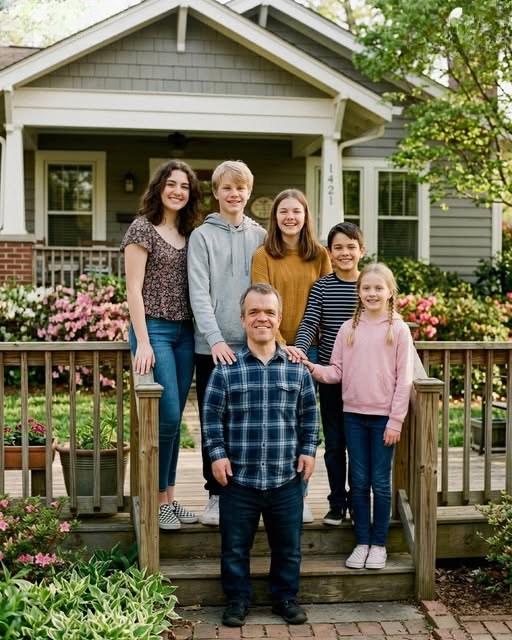
Ten years earlier, my wife told me she was stepping out to buy milk and left me behind with five children, one still a baby smelling of powder and formula. She never came back. On this Mother’s Day, she appeared at my door as if no time had passed, and what my oldest daughter did in that moment left me completely speechless.
I was in the supermarket’s hygiene aisle holding a pack of sanitary pads, trying to recall which brand Maya said her sisters preferred.
A teenage girl and her mother were ahead of me in line. The girl looked embarrassed, cheeks burning red. Her mother leaned in and said something quietly reassuring, and the girl smiled. I glanced into my basket and thought how Natalie should have been the one guiding our daughters through moments like this.
June, my third daughter, had started her period that morning.
I WAS IN THE SUPERMARKET’S HYGIENE AISLE HOLDING A PACK OF SANITARY PADS.
I had already been through this twice before with Maya and Ellie, so I knew the routine by heart. Pads, chocolate, painkillers, something warm, something comforting, and acting like it was all completely normal.
The cashier glanced at my basket and then at me. “First time?” she asked.
“Third daughter,” I answered.
She lifted a pack of gummies. “These help. Maybe a heating pad too?”
I took both without hesitation.
By now, strangers could easily read my life in a glance.
Single father. Five kids. No wife anywhere in sight.
The truth was obvious. But none of them knew how it started—the night Natalie said she’d be back in fifteen minutes and never returned, leaving me frozen in the kitchen with a baby in my arms and four children asking when their mother would come home.
BY NOW, STRANGERS COULD READ MY LIFE IN A GLANCE.
Ten years ago, she left on an ordinary Wednesday.
She kissed the baby’s forehead, grabbed her purse, and said she was going to get milk. Rosie was only six months old. Maya was six. The others were spaced in between, close enough that the house was always filled with noise, toys dropping, and someone calling out for help.
Fifteen minutes passed. Then half an hour. Then more.
I called her phone until it went silent. Then I went to grab my jacket—and that’s when I saw the closet. Half-empty in a way that said everything. Her nicer clothes were gone. The suitcase was gone. Even the cash drawer was wiped clean.
It had been planned.
SHE KISSED THE BABY’S FOREHEAD, GRABBED HER PURSE, AND SAID SHE WAS GOING TO GET MILK.
I sat on the bed and cried quietly so the children wouldn’t hear.
Maya appeared first at the doorway. “Dad? Where’s Mom?”
“I don’t know yet, sweetheart.”
For a long time, I truly didn’t. Then whispers started. She’d been seen with a wealthy man. Then another. New clothes. Expensive places. Different cities.
Eventually, I stopped asking. The house still needed running. My mother moved in three days later. That’s how we survived.
At night, when the kids were asleep, I’d sit in the laundry room just so they couldn’t hear me break down.
“DAD? WHERE’S MOM?”
I worked three jobs at first. Early warehouse shifts, afternoon deliveries, and evening bookkeeping for a plumbing business that mostly paid in exhaustion.
My mother kept the home running while I kept us afloat financially. When she died two years ago, it felt like losing the only person holding everything together with sheer will and grocery lists.
Still, we managed. Somehow.
Maya grew into someone who noticed everything before anyone spoke. Owen became the one who lifted weight without being asked. Ellie learned how to calm Rosie with laughter. June turned pain into jokes. And Rosie—the baby who never knew her mother—grew up believing I could fix almost anything if I just had coffee first.
That kind of trust isn’t earned cleanly. Fathers just try not to break it.
WE STILL MANAGED.
The kids met me at the door when I returned. Rosie went straight for snacks. June checked if I remembered chocolate. Maya quietly took the pads without comment, like she always handled private things for her sisters.
That was life—busy, loud, but ours.
That Saturday dinner, Owen asked if we were still visiting Grandma’s grave the next day.
“After church,” I said.
Rosie complained about the food, then ate anyway. June declared periods were ridiculous. Ellie argued back until laughter filled the table. Maya laughed so hard she almost choked.
THAT WAS LIFE—BUSY, LOUD, BUT OURS.
I looked around and felt that quiet pressure in my chest that parents know too well—love so heavy it almost hurts.
On Sunday, we went to the cemetery, came back, warmed leftovers, said grace, and sat down for a Mother’s Day meal meant for my mother—not the woman who had disappeared from my children’s lives.
Then the doorbell rang.
The moment I opened it, I went still.
Natalie was standing there like she belonged somewhere far more polished.
Neat coat, expensive shoes, hair done perfectly casual. For a moment, my mind refused to connect her to the woman who had left five children without a goodbye.
NATALIE WAS STANDING THERE LIKE SHE BELONGED SOMEWHERE FAR MORE POLISHED.
She brushed past me before I could react and walked straight into the dining room. The kids froze. Rosie instinctively hid behind Owen.
Then Natalie started crying loudly.
“I missed you all so much.”
No one moved.
Then she turned and said something that hit like a punch. “I left because of your father. He couldn’t provide a good life for us.”
I saw confusion spread across my children’s faces.
She kept talking, reshaping the past in real time, insisting she had only stepped away “temporarily,” that she had sacrificed, that she had changed.
I SAW CONFUSION SPREAD ACROSS MY CHILDREN’S FACES.
Her eyes scanned the house—old curtains, worn cabinets, the simple meal on the table—as if she were judging everything she had once abandoned.
Rosie grabbed Owen’s hand. That nearly broke me.
Natalie crouched down. “Baby, it’s Mommy.”
Rosie looked past her, straight at me.
“Why are you here?”
My voice came out low. “What do you want?”
“I want my family back,” she said.
“The family you left behind with no food and no explanation?”
She didn’t react. “I can give them more now.”
That’s when Maya stood.
“Dad…”
I stopped.
She looked at Natalie calmly. No anger, no panic.
Then she said, “We’ve been waiting ten years for this moment.”
Natalie smiled through tears. “I knew you’d understand.”
Maya walked to the cabinet and pulled out a small wrapped package.
“I KNOW YOU’D UNDERSTAND.”
Natalie took it, already expecting gratitude. She opened it slowly.
Her expression collapsed.
“HOW DARE YOU?” she shouted.
I moved instinctively toward them.
Inside the package was a card in Maya’s handwriting:
“WE DON’T NEED YOU. LEAVE.”
Under it were old drawings, torn photos, and Mother’s Day cards made over the years—some childish, some faded, all carefully kept.
Natalie’s hands shook. “What is this?”
Maya said softly, “Everything we made for you while you were gone.”
Owen pointed at one. “That one was mine. I was seven.”
Ellie added another, voice tight. “Mine said I saved you dessert.”
June cried quietly. “Mine said maybe you’d come back.”
Then Maya read the last one aloud:
“We stopped waiting for you.”
Silence filled the room.
“You didn’t just leave me,” I said. “You left children who kept hoping.”
Natalie whispered, “I didn’t know.”
Owen answered immediately. “You never stayed long enough to find out.”
Rosie said simply, “I love Dad.”
That was the moment everything shifted. My chest tightened—not from pain, but from pride I didn’t expect to feel so sharply.
THE SILENCE FILLED THE ROOM.
Maya opened the door. “You should go.”
Natalie pleaded, but Maya didn’t move.
“You already did this,” she said.
I followed Natalie outside.
Her car sat waiting. She held the box tightly, shaking.
“I came back because I needed them,” she said.
Not missed. Not loved. Needed.
I looked at her. “That’s not what parenting is.”
From inside, Owen called, “Dad, food’s getting cold!”
Maya followed, “Leave her and come eat.”
I exhaled slowly.
My children had stopped waiting for her long before I did.
And that said everything.
I walked back inside.
We reheated dinner. Laughter slowly returned. Plates passed around. Life continued.
Later, Rosie sat on my lap.
“Are you sad, Dad?”
“Just a little.”
“I’m not,” she said.
That made me smile.
Later that night, Maya stopped at the doorway.
“We never needed her,” she said. “Just you.”
After she left, I sat down.
Because some truths don’t hit like words. They settle into the places that carried weight for years.
Natalie gave them life. I gave them everything after that.
And somehow, that was enough.