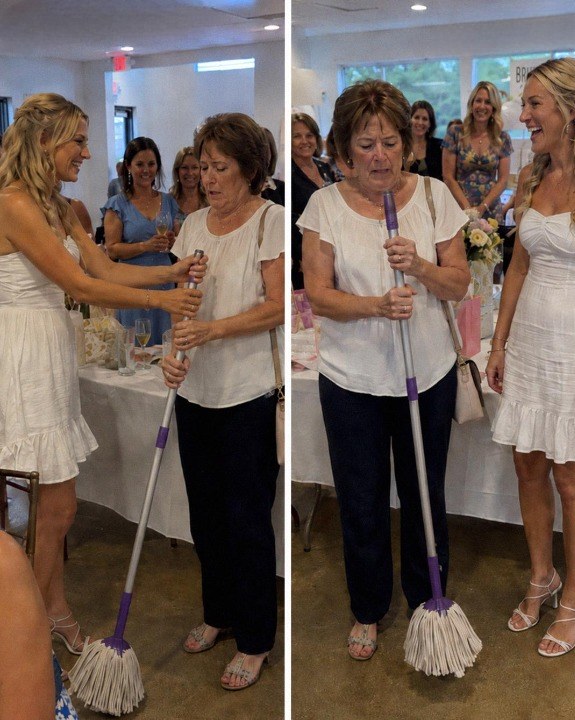
At my future daughter-in-law’s bridal shower, I expected uncomfortable small talk, forced smiles, and an afternoon where I would quietly try not to feel out of place. I never imagined I would walk out wondering whether my son truly understood the woman he was preparing to marry.
My husband died when our son, Daniel, was only eight years old. One day I was a wife and mother, and the next I was a grieving widow desperately trying to keep food on the table and the electricity running.
I accepted the first stable work I could find.
Janitorial work.
I cleaned schools, office buildings, clinics, and anywhere else willing to pay me for scrubbing floors and emptying trash bins.
So six months ago, when Daniel called me and said, “Mom, I’m going to propose to Emily,” I stood there crying over a bucket of floor cleaner.
Emily always kept me at arm’s length.
She was polite enough on the surface, but there was always something underneath her smile. Small comments. Little digs. Questions about when I planned to “move up in life.” It was obvious she believed she came from a better world than mine.
Still, families are complicated, and I genuinely believed things might improve after she invited me to her bridal shower.
Looking back now, I should’ve trusted my instincts the moment I opened that invitation.
When I arrived at the event, Emily stood beneath a giant balloon arch wearing a pale pink dress that probably cost more than my monthly grocery budget.
She looked me over and said flatly:
“Oh. You actually came.”
“I wouldn’t miss it,” I replied warmly while holding out the gift bag I’d brought.
She took it delicately between two fingers like she didn’t want it touching her too long.
“Hm. Okay.”
That was it.
No hug.
No thank you.
No compliment.
Nothing.
Then, about halfway through the afternoon, Emily suddenly stood and clapped her hands loudly for attention.
“Okay, ladies,” she announced brightly. “Before lunch, we’re going to do something fun.”
The women laughed politely.
Then Emily reached for a completely full glass sitting beside her and deliberately let it slip from her hand.
The glass shattered dramatically across the floor.
Liquid spread everywhere.
And then she looked directly at me.
Not the catering staff.
Not the event host.
Me.
She bent down, picked up a mop sitting near the serving station, walked over calmly, and held it out toward me with a sweet smile.
“Since you didn’t really contribute much,” she said cheerfully, “you can at least work for your lunch. You should already be pretty used to this anyway.”
The entire room fell silent.
I froze.
Somebody coughed awkwardly somewhere in the back, but otherwise the room was dead quiet.
I could feel every single pair of eyes staring at me.
Emily tilted the mop toward me again.
“Go ahead.”
And in that moment, I really looked at her.
Not at her dress.
Not at her makeup.
At her expression.
She was enjoying it.
Not nervous laughter.
Not awkwardness.
Enjoyment.
That was the exact moment something inside me turned cold.
I didn’t take the mop.
Instead, I calmly placed my purse on the table, unzipped it, and reached inside.
Then I pulled out a silver key tied to a faded blue ribbon.
Emily frowned immediately.
“What exactly are you doing?”
I held up the key and answered calmly:
“This was supposed to be your wedding gift.”
She blinked in confusion.
“What is it?”
“It’s the key to a condo Daniel and I have been saving toward. The down payment was going to be my gift to both of you.”
Across the room, someone whispered:
“Oh my God.”
I wrapped my fingers tightly around the key and continued speaking.
At first my voice trembled slightly.
Then it steadied.
“I’ve spent nineteen years cleaning floors. I worked double shifts. I skipped vacations. I wore shoes until the soles literally split apart. Every spare dollar I could save, I saved. Not because I wanted praise. Not because I wanted recognition. Because I wanted my son to begin his marriage with security instead of debt.”
Emily stared at me like she no longer understood the conversation.
I tightened my grip on the key.
“But gifts should go where they’re appreciated,” I said quietly.
Then I picked up my coat and walked out.
I made it all the way to my car before I started crying.
Not delicate tears.
The kind that hurt in your chest.
I sat gripping the steering wheel whispering to myself:
“You are not going to fall apart because of that girl. You are not.”
Eventually I drove home, changed clothes, removed my makeup, and started heating soup in the kitchen.
That was when Daniel called.
His voice sounded tense immediately.
“Mom… what happened?”
I answered honestly.
“Emily humiliated me in front of twenty people.”
He sighed heavily.
“She said there was some misunderstanding.”
“A misunderstanding?”
“She said she made a joke and you suddenly walked out after giving some speech about money.”
Very quietly, I asked him:
“Did she mention handing me a mop and telling me to earn my meal because I’m used to cleaning floors?”
Silence.
Then:
“What?”
“Did she tell you that part?”
“No.”
“Did she mention setting the whole thing up in front of her guests so they could laugh at me?”
Another long silence followed.
Then he asked something that hurt almost as badly as Emily’s behavior itself.
“Mom… are you sure that’s what she meant?”
I closed my eyes.
“I know the difference between a joke and humiliation.”
He didn’t answer for several seconds.
Finally he muttered:
“Let me talk to her.”
The following morning, someone started pounding aggressively on my front door while I folded laundry.
I opened it to find Emily standing there.
No pink dress.
No fake sweetness.
No smile.
Just anger.
She pushed inside without waiting to be invited.
“I need to know what game you’re playing,” she snapped immediately.
I stared at her.
“Excuse me?”
“You embarrassed me on purpose.”
I almost laughed from disbelief.
“You think I embarrassed you?”
“Yes,” she shot back. “Bringing up the condo in front of everyone and then taking it away was cruel.”
“Cruel?” I repeated.
“That gift was supposed to be for Daniel.”
“It was for Daniel and the woman he planned to marry. I’m no longer convinced that woman deserves it.”
Her jaw tightened instantly.
“All this because of one joke?”
I pointed toward the door.
“You handed me a mop.”
She rolled her eyes dramatically.
“You took it way too personally. You don’t understand how things work in my social circle.”
I stared at her.
“Look, I understand we come from different backgrounds,” I said slowly. “But you made this personal.”
Then she stepped closer and said:
“You’ve never liked me.”
I let out a short breath.
“I tried very hard to like you.”
She ignored that entirely.
“You’ve always wanted Daniel dependent on you.”
For one second, I genuinely couldn’t breathe.
Then she said the ugliest thing she possibly could have said.
“You know what he says about you? That you mean well, but you make things awkward. That you don’t really fit into our world.”
Something inside me snapped.
I pointed directly at the door.
“Get out.”
She still tried one final insult.
“You can’t stand that he’s moving up in life.”
I opened the front door myself.
“Out, Emily.”
She finally left.
The second the door shut behind her, I leaned against it shaking.
Then I called my son.
“Come over,” I told him quietly. “Alone.”
He arrived that evening looking exhausted and somehow older than he had just days earlier.
The moment he sat down, I asked:
“Did Emily come here because of you?”
His forehead wrinkled.
“What?”
“She showed up this morning. She accused me of trying to control you. She claimed you said I don’t fit into your world.”
His face changed immediately.
“She said that?”
“She did.”
He covered his mouth with one hand.
“Mom… I never said that.”
And I believed him.
So I told him everything.
Every word from the bridal shower.
Every word from my living room.
When I finished, he sat staring silently at the floor for a long time.
Eventually he rubbed his forehead and admitted quietly:
“She’s made comments before. About your clothes. Your work. Small things. I kept convincing myself she didn’t mean it.”
I asked softly:
“Did you ignore it because that was easier than admitting what it said about her?”
He looked at me with red eyes.
“Yeah.”
Then I removed the condo key from my pocket and placed it carefully on the table between us.
“This key isn’t really about property,” I told him. “It represents years of sacrifice. Sick days I worked through. Overtime shifts. Every exhausting thing I did because I believed you were building a life with someone kind.”
His eyes filled with tears.
Then I said quietly:
“I can survive being insulted. What I cannot survive is watching my son stand beside cruelty and call it love.”
That finally broke him.
“I’m sorry,” he whispered. “I’m so sorry.”
I squeezed his hand, but I didn’t rescue him from the pain.
He needed to feel it.
That night, he went directly to Emily’s apartment.
Later, he told me exactly what happened.
The first thing he asked her was:
“Did you hand my mother a mop and tell her to work for her food?”
Emily tried dodging the question immediately.
“It was a joke.”
“Answer me.”
Finally she snapped:
“Yes, I did it. But everybody’s acting like I committed some horrible crime.”
Then Daniel said something that changed everything.
“You humiliated my mother.”
And instead of apologizing, Emily replied angrily:
“Your mother walked in there acting like she belonged.”
That was the moment everything became clear to him.
Not rage.
Not confusion.
Clarity.
He removed his engagement ring and placed it on her kitchen counter.
“What are you doing?” she demanded.
“Ending this.”
She laughed bitterly.
“You’re choosing her over me?”
And my son answered:
“No. I’m choosing decency over humiliation.”
She screamed. She cried. She called him stupid.
He walked out anyway.
Later that night, he came to my house.
When I opened the door, he looked completely shattered.
“It’s over,” he said quietly.
I stepped aside and let him in.
He sat at the same kitchen table where he once did homework while I packed school lunches.
Then he looked at me and whispered:
“I should’ve protected you.”
I stayed silent.
He continued:
“Every time she made one of those comments and I ignored it, I taught her she could keep doing it. I failed you.”
Those words hurt, even though I needed to hear them.
“I didn’t raise you to be ashamed of me,” I said quietly.
He shook his head immediately.
“I’m not ashamed of you. I’m ashamed of myself.”
Weeks passed.
The wedding was canceled.
Money was lost.
People talked.
One of the women from the bridal shower even sent me a message apologizing for staying silent. She admitted Emily had hinted beforehand about having “a funny surprise” planned for me.
So yes.
It had all been intentional.
But something else changed too.
Daniel started showing up more often.
Not because of guilt.
Because he was trying.
Really trying.
One afternoon we met at the diner he used to love as a child.
When I walked in, he stood immediately and hugged me tightly.
Over grilled cheese sandwiches and tomato soup, he said quietly:
“I keep thinking about that key.”
I smiled faintly.
“It’s still mine.”
“It should be.”
Then he slid a tiny box across the table toward me.
Inside was a plain metal keychain engraved with one sentence:
For the home you taught me to deserve.
I cried right there in the diner booth.
Then Daniel said softly:
“I don’t want that condo until I’ve actually become someone worthy of what it cost you.”
And honestly?
That meant more to me than the wedding ever could have.
The silver key still sits inside my drawer tied to that faded blue ribbon.
Maybe someday I’ll give it to him.
But now I know something for certain.
A person can spend half their life scrubbing floors and still carry far more dignity than someone dressed in silk holding a champagne glass.
And finally, my son understands that too.