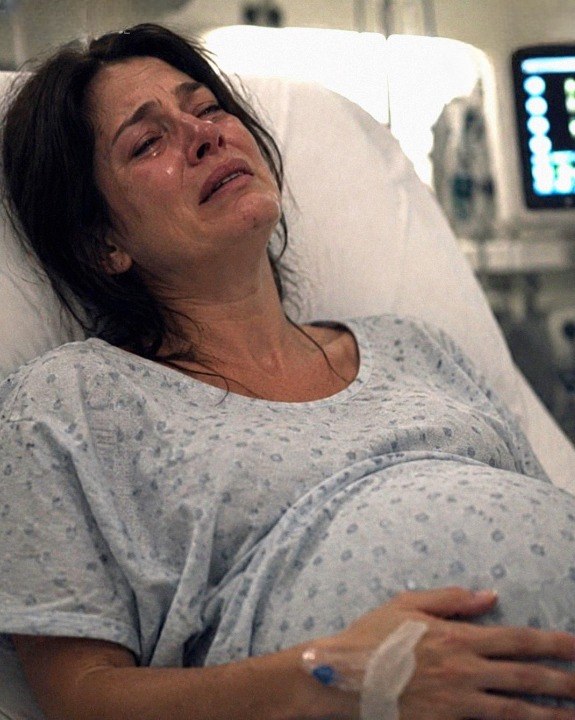
After enduring the heartbreak of seven failed pregnancies and watching her husband abandon what felt like their final chance to become parents, Emilia lay alone in a hospital room struggling to keep her unborn child alive. Then, in the middle of a terrifying medical emergency, doctors uncovered a truth they should have discovered months earlier.
The heart monitor beside Emilia’s hospital bed kept a steady rhythm, green lights blinking softly against the pale walls of St. Carmel Medical Center.
Outside her window, the Ohio sky stretched endlessly in dull shades of grey, the kind that made the afternoon feel dark and heavy long before sunset. Emilia had spent the past two weeks confined to that room, and the silence carried a crushing weight of its own.
She shifted slightly against the pillows and rested her hand carefully over the curve of her stomach.
“We’re still here,” she whispered softly. “You and me.”
At forty years old, Emilia had spent fifteen years trying to bring a child home to the little house on Grover Street, the same house where a gravestone rested quietly in the backyard garden. Most people did not have gravestones behind their homes.
But Emilia did.
The stone carried the name Noah, etched into pale grey granite worn smooth at the edges because Emilia touched it so often.
Noah had been her sixth baby. Unlike the others, he had actually been born alive. He survived only four hours before his tiny heart stopped beating in her arms, and during those four hours, Emilia never once let go of him.
The door opened as Nurse Rosa entered carrying a chart and a cup of water balanced in one hand.
“Time to check your blood pressure,” Rosa said. “And afterward, you’re eating something whether you want to or not.”
“I’m not hungry,” Emilia muttered.
“I wasn’t asking.”
Rosa was in her mid forties, practical and blunt in the way only years of working in high risk obstetrics could create. Since Emilia’s transfer from Riverside Clinic two weeks earlier, Rosa had become the one constant source of stability in her life.
“David called the front desk again,” Rosa mentioned while setting the chart down. “Twice this morning.”
Emilia kept staring toward the window.
“He can keep calling.”
She had spent twelve years with David. Through every failed pregnancy, she had watched his silences grow longer and his frustration deeper. Each loss tightened something inside him, but Emilia convinced herself grief simply affected people differently. She believed that for long enough to become pregnant an eighth time.
“You’re fighting nature,” he told her two months earlier while standing at the doorway holding his overnight bag. “Maybe we were never supposed to have children.”
Emilia said nothing then.
Instead, she turned toward the window with one hand resting protectively on her stomach while listening to his footsteps disappear down the hallway.
“Has he visited since?” Rosa asked gently.
“Not after that day.”
Rosa simply made a note on the chart and didn’t push further.
The disorder tormenting Emilia’s body had taken doctors months to identify correctly. MRKH variant syndrome combined with immune rejection complications was so rare that the team at Riverside Clinic initially spent months treating the wrong problem entirely.
St. Carmel had better technology, a larger medical staff, and Dr. Harmon, a physician who examined medical records the way lawyers examined evidence, always searching for the detail everyone else missed.
Every night, Emilia spoke quietly to her unborn child.
Resting her palm against her stomach, she repeated the same promise she had made during every previous pregnancy, only this time with more determination.
“You’re going to survive,” she whispered. “This time will be different.”
She needed to believe that because hope was the only thing she still had left.
Reaching for her phone on the bedside table, she noticed the voicemail notification she had spent all morning avoiding. David had called at 7:14 a.m. while she lay awake staring at the ceiling.
She still hadn’t listened to it. Perhaps because deep down, she already knew what it contained.
The voicemail sat untouched until finally, after hours of hesitation, Emilia pressed play.
David’s voice sounded flat and rehearsed, as though he had practiced every word before recording it.
“Emilia, I moved my things out yesterday. I can’t keep doing this anymore. Some things aren’t meant to happen, and I think you know that too. I’m sorry.”
Emilia turned the phone face down on the blanket.
Three minutes later, Rosa entered carrying her clipboard and immediately noticed Emilia’s expression.
“Vitals first,” Rosa said before pausing. “Actually, maybe we talk first. What happened?”
“He left,” Emilia answered quietly.
“When?”
“Apparently yesterday. He told me through voicemail.”
Rosa set down the clipboard and sat beside her without rushing to fill the silence.
“He already said something similar two months ago,” Emilia admitted. “He stood in that doorway with his overnight bag and told me I was fighting nature. That maybe we were never meant to have children.”
“What did you say back then?” Rosa asked.
“Nothing. I thought grief was making him say things he didn’t mean. I thought he’d come back.”
“And now?”
“Now I have a voicemail.”
Rosa gently took Emilia’s wrist, checking her pulse the old fashioned way.
“You still have me,” Rosa said softly. “And you still have Dr. Harmon. None of that changed.”
An hour later, Dr. Harmon entered the room. He was a careful, methodical man in his early fifties who delivered both good and terrible news with the exact same calm tone. But this time, tension edged his voice.
“Emilia, you need to listen closely,” he said. “Your condition is worsening.”
She stared at him silently.
“Your immune rejection markers are climbing rapidly. The pattern is escalating.”
Emilia gripped her swollen stomach so tightly her knuckles turned white.
“What does that mean for my baby?”
Dr. Harmon folded his hands carefully.
“The disorder affecting you is exceptionally rare,” he explained. “Your body is beginning to reject the pregnancy. At this stage, your system and the fetus may no longer be compatible.”
“And what happens then?” she whispered.
“It means we may soon face a situation where a choice becomes necessary.” He paused carefully. “Your survival or continuing the pregnancy.”
Tears slid down Emilia’s face before she even realized she was crying.
“No,” she whispered brokenly. “I’m finally this close. I can’t make that decision.”
“I’m not asking you to choose today,” Dr. Harmon assured her. “But I need you to understand how serious this has become.”
Emilia stared at the ceiling briefly before looking back at him.
“Is my baby in danger right now?”
“The baby is stable. You are the one deteriorating.”
Rosa entered holding a folder and handed it to Dr. Harmon. He glanced at it, frowning slightly.
“There’s something else,” he said carefully. “When your records were transferred from Riverside Clinic, my team noticed inconsistencies in the ultrasound imaging. We asked a second radiologist to review everything.”
“Inconsistencies with what?” Emilia asked.
“Mostly positioning issues. Possibly faulty equipment. We’ll know more soon.”
After he left, Emilia barely processed the conversation because one word echoed endlessly in her mind.
Choice.
She rested her hand against her stomach and felt movement beneath her skin. Slow. Deliberate.
The Riverside notes claimed the unusual pressure came from fluid retention and swelling caused by the immune complications. Emilia had read those notes repeatedly.
But as she lay there with her hand spread across her belly, counting the movements, something felt strange.
Almost like there was more than one presence inside her.
She dismissed the thought immediately. Exhausted, frightened people imagined things.
Rosa returned to finish her vitals while the room remained quiet for several minutes.
“Do you think Dr. Harmon will actually find something?” Emilia finally asked.
Rosa tightened the blood pressure cuff before answering.
“Dr. Harmon is the kind of man who doesn’t stop until he understands every detail,” she said. “Depending on the day, that can either be comforting or terrifying.”
“And today?”
“Today, I think it’s comforting.”
Outside the window, the afternoon sky darkened further. Emilia lay back against the pillow and pressed her palm against the constant movement inside her.
“I hear you,” she whispered. “I’m still here.”
Meanwhile, down the hallway, Dr. Harmon stood at his desk staring at the Riverside records and the preliminary report from the second radiologist, his face unreadable.
The next afternoon, David unexpectedly returned carrying only his coat and the heavy silence of a man who had rehearsed difficult words ahead of time.
Emilia watched him carefully.
“I didn’t think you’d come back,” she admitted.
“I never stopped caring about you,” David replied while sitting nearby without touching her. “That’s why I’m here.”
“You cared enough to leave a voicemail.”
David looked down at his hands.
“You need to hear me out.”
“Then talk.”
“The doctors already explained what’s happening to your body,” he said slowly. “Continuing this pregnancy isn’t bravery anymore.”
“Then say what you actually mean,” Emilia replied.
“You’re risking your life for a baby who may not survive either.”
The machines continued humming steadily around them while Emilia felt movement roll heavily inside her stomach.
“You don’t get to decide what I owe this child,” she answered quietly.
“I’m trying to be rational.”
“You spent twelve years asking me to stop hoping,” she replied. “I just never realized it until now.”
David moved toward the window.
“I’ve already lost everything there is to lose,” he said bitterly. “Seven times.”
“I know exactly how many,” Emilia whispered. “I was there for every single one.”
Then David revealed something far worse.
“I spoke with hospital administration,” he admitted. “About whether you’re emotionally capable of making medical decisions under this kind of pressure.”
Emilia froze.
“You did what?”
“I only raised concerns. Somebody needs to think clearly.”
“Get out.” Her voice remained perfectly steady.
“Emilia, please…”
“You came here to take this decision away from me because you couldn’t survive the grief anymore,” she said. “I understand that. But don’t pretend it’s love. Get out of my room.”
He lingered only a moment longer before quietly leaving.
Rosa appeared less than a minute later as if she had been waiting nearby.
“I heard enough,” Rosa admitted gently while checking the monitors. “You okay?”
“No,” Emilia answered honestly.
“Good. Honest answers matter.”
Rosa adjusted the IV line before speaking again.
“The radiologist finished reviewing the Riverside scans,” she said carefully.
“What did they find?” Emilia asked immediately.
“Dr. Harmon wants to explain it himself.”
Emilia looked down at her stomach.
Then suddenly, the monitors screamed.
A sharp alarm shattered the room’s silence. Rosa reacted instantly, slamming the call button while leaning over Emilia.
“Stay with me!”
Medical staff flooded into the room. Machines beeped wildly while trays rattled across metal carts.
One doctor adjusted the fetal monitor and immediately went pale.
“We’re losing both heartbeats!”
Another wave of agony ripped through Emilia’s abdomen, pulling a scream from her throat.
Dr. Harmon burst through the doors still holding the corrected imaging scans. His eyes darted from the monitors to Emilia and back again.
“We need a decision right now!” one physician shouted. “If we save her, the baby dies. If we try saving the baby…”
“The rejection markers are spiking,” another warned. “If her body crashes completely, we lose them both.”
Dr. Harmon stared hard at the monitors.
Something didn’t make sense.
The fetal patterns were overlapping strangely, almost doubling over each other in ways that didn’t match a normal immune rejection collapse.
Then his eyes dropped to the corrected imaging scans.
Suddenly, everything clicked into place.
He rushed to Emilia’s bedside.
“Emilia, listen carefully,” he said urgently. “We found the real problem.”
Through the haze of pain, she struggled to focus.
Dr. Harmon held up the scans.
“You’re carrying twins,” he said. “Two babies. The second heartbeat was hidden because of transfusion syndrome between them. Riverside completely misread your scans.”
Emilia stared at him in disbelief.
“Two?” she whispered weakly.
“A boy and a girl,” he confirmed. “Both are in distress, but your body isn’t rejecting a single pregnancy the way we originally believed.”
Rosa squeezed Emilia’s hand gently.
“The choice they forced on you was based on the wrong diagnosis,” Rosa said softly. “It was never your life versus the baby.”
Another contraction tore through Emilia’s body as years of grief and heartbreak crashed over her all at once.
“What happens now?” she asked weakly.
Dr. Harmon didn’t hesitate.
“We perform emergency surgery,” he said firmly. “Your body is under tremendous strain, but now we fight for all three of you.”
Emilia closed her eyes for a moment.
Then she nodded.
“Do everything you can,” she whispered. “For all of us.”
The operating room was freezing cold, painfully bright, and overwhelmingly loud. Emilia lay trembling at the center of it all.
She closed her eyes and thought about Noah.
“Your brother and sister are coming,” she whispered softly. “Stay with them.”
Then darkness swallowed everything.
When Emilia woke up, she heard crying.
Not one cry.
Two.
Small, angry, determined cries that sliced through the fog of anesthesia and settled deep inside her chest.
Rosa stood beside her with tears in her eyes.
“They’re here,” Rosa whispered. “Both of them.”
Dr. Harmon appeared in the doorway.
“Clara and Noah are in the NICU,” he explained. “They’re tiny, but stable. You made it through, Emilia. All three of you did.”
Only then did Emilia finally allow herself to cry, not from grief this time, but from relief so overwhelming she had almost forgotten such a feeling existed.
Weeks later, Emilia sat beside two NICU bassinets while Rosa adjusted Clara’s blanket gently.
The babies were still small, still surrounded by wires and monitors, but their cries had grown stronger. Strong enough to fill the room with life.
Rosa looked down at the twins and smiled softly.
“They fought hard to get here.”
Emilia looked at her sleeping son and daughter, tears filling her eyes again.
“So did I,” she whispered.
Rosa rested a comforting hand on her shoulder.
“And this time,” Rosa said gently, “all three of you survived.”