I had planned a quiet Mother’s Day with my son, the kind I used to imagine while quietly dealing with my own worsening health. But when he lied about being ill and chose a far more “important” dinner instead, I ended up walking into his world with an envelope that shifted everything between us.
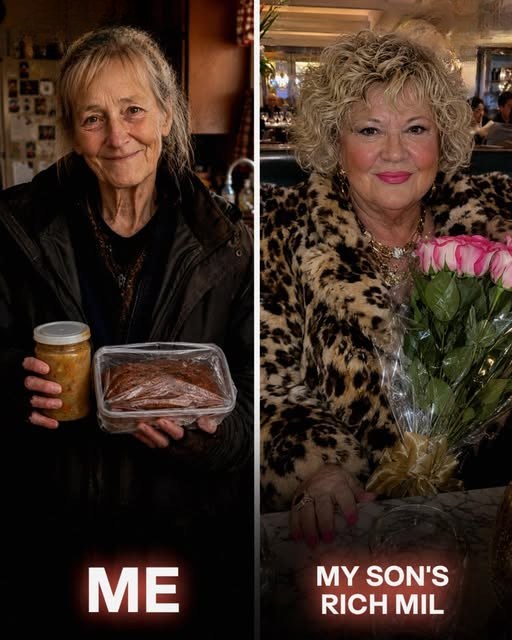
I realized my son wasn’t sick while standing outside his apartment, holding homemade chicken soup in one hand, banana bread in the other, and the last of my money for medication tucked under my arm.
For a brief moment, I still tried to shield him in my thoughts.
Maybe his wife had taken the car. Maybe he had gone out briefly. Maybe he was upstairs resting, unaware I was there.
That’s what mothers do. We soften reality so it hurts less.
But the truth didn’t wait long.
The doorman glanced at my bags and said, “Joe? He left about an hour ago, ma’am. Suit on. Said he was going to a restaurant across from the bridal shop to meet his wife’s mother.”
My hands went cold around the soup container.
“The expensive one?” I asked.
He nodded. “Mother’s Day dinner, I think.”
Mother’s Day dinner.
“He left about an hour ago, ma’am.”
That morning, I had ironed my blue dress twice.
It was the best thing I owned, though one sleeve had already begun to shine with wear. I laid it on the bed, then sat down because the room felt like it tilted beneath me.
“Not today,” I whispered, pressing my hand to my ribs. “Not today.”
My doctor had told me to slow down. I had nodded politely and promised I would.
Then I went home and cooked anyway.
A small roast, nothing fancy, the kind with a discount sticker half hidden on the packaging. I peeled carrots, mashed potatoes, and baked Joe’s favorite banana bread.
“You’re not ruining today,” I told myself again.
When he was a child, he would hover near the oven asking every few minutes if it was ready yet.
After his father died, banana bread became everything—comfort, celebration, apology, even survival.
I set two plates on the table.
One for me.
One for Joe.
The empty chair looked patient, like it still believed he would come.
At 10:30, the phone rang.
“Thank you for making me a mom,” I whispered softly before answering.
Joe coughed through the line. It sounded rehearsed, but I pushed the thought away.
“Ma, I’m sorry. I think I caught the flu. I feel terrible.”
My chest sank. “Oh sweetheart… fever?”
“Yeah. Chills. Everything.”
“Did your wife help you?”
“She’s out with her mom. I told her not to cancel. I’ll be okay.”
“I’ll be okay.”
“We’ll do another day then,” I said gently.
“Thanks, Ma. I knew you’d understand.”
I looked at the roast cooling on the counter. “Of course I do.”
After the call, I sat staring at the plates until my eyes stung.
I almost removed his plate.
Then I didn’t.
That’s the problem with mothers—we keep space for people who already left it empty.
I wrapped the bread, packed the soup, and counted my money.
Forty dollars.
At the pharmacy, I replaced brand-name medicine with cheaper versions. I put back throat lozenges for generic ones instead.
By the time I reached his building, my arms ached and my breathing felt shallow. His parking spot was empty.
That’s when the doorman told me the truth.
I could’ve gone home.
Instead, I sat in my car, the medicine beside me, and pulled out the envelope.
It didn’t belong there. It belonged at my kitchen table.
Not in a restaurant full of glass, gold, and people who didn’t know me.
Not in front of Eleanor.
But I still held it.
I had pictured the moment carefully—Joe sitting across from me, complaining I made too much food, me telling him he always took it anyway.
Then I would slide it across the table.
“Open it, sweetheart.”
That had been the plan.
A month earlier, he had sat at that same table.
“This would change everything,” he said, rubbing his forehead. “It’s not just a car. It’s status. It’s opportunity.”
“How much?” I asked.
He exhaled. “Too much.”
“How much, Joe?”
“Thirty thousand.”
I let out a small breath. “That’s a lot of opportunity.”
He gestured vaguely around my small kitchen. “You don’t understand what people expect in her family.”
“I understand more than you think,” I said quietly. “I’ve been judged my whole life.”
His voice softened. “I just want respect.”
“Then earn something real,” I said.
He didn’t answer.
So I sold my home.
Not the one where I raised him—that had been gone long ago. This was the small place I managed to build later after years of exhaustion and sacrifice.
A buyer had already signed. I had weeks left.
My friend Ruth told me her daughter had a small studio behind her house.
“It’s enough,” she said.
Maybe it was.
Maybe smaller was fine.
I told myself Joe needed the money more than I needed comfort.
But truthfully, I just wanted one last Mother’s Day with him sitting at my table.
At 5:40, my phone lit up.
Chelsea had posted a photo.
Joe sat under elegant lights, smiling beside his wife’s mother. No illness. No exhaustion. Just polish.
Caption: “Grateful for the woman who always shows up for us.”
My hands tightened around the soup container.
Then I looked at the envelope again.
“Alright,” I whispered. “Then you’ll get it here.”
The restaurant was polished, bright, and full of people who looked right through me.
The hostess hesitated at my coat and paper bag.
“Do you have a reservation?”
“No,” I said. “I’m just here for my son.”
“I can pass it to him.”
“No.” I held the envelope tighter. “I brought it this far myself.”
And I walked past her.
I found them near a window.
Eleanor sat perfectly composed. Chelsea smiled beside Joe. He looked like someone else entirely.
Then he raised his glass.
“To Eleanor,” he said. “The woman who deserves the name Mom.”
Chelsea’s smile flickered.
I kept walking.
Eleanor smiled politely. “That’s very kind.”
Joe leaned closer to her. “About the car… if you still want to help, I won’t let you down.”
I stopped at the table.
His eyes met mine—and dropped instantly.
“Mom?”
I looked at him. “You look healthy for someone who couldn’t come see me.”
Chelsea straightened. “Marianne, please sit.”
Eleanor blinked. “Joe said you were resting.”
I shook my head slowly.
Joe stood too fast. “I can explain.”
I placed the envelope down.
“No. Let me.”
His name was written on it in my handwriting.
“What is that?”
“Open it.”
“Not here.”
“This is where you chose to be.”
Chelsea frowned. “Joe, what’s happening?”
He tore it open.
Inside was a medical letter. Clear, direct. No softness. My time wasn’t unlimited.
His face drained of color.
Then a check—thirty thousand.
And my note.
He read it once. Then again.
“I wanted to give this to you at home. The house is being sold. I thought I was giving you something to help your future. I only wanted one last Mother’s Day with you.”
His hands shook.
“This was supposed to be our last one?” he whispered.
I nodded slightly. “The doctor said it plainly. I asked him to.”
Joe covered his mouth. “Why didn’t you tell me?”
“I tried to see you.”
Chelsea stood. “You left her waiting?”
Joe looked lost. “I didn’t know.”
Eleanor pushed her chair back. “You said your mother didn’t care.”
“I wasn’t being honest,” he said quickly.
“That’s the difference,” she replied.
He broke completely then.
“I didn’t mean to hurt her,” he said.
I looked at him. “You didn’t think about me at all.”
“You can’t buy back time,” I added softly.
And I left before I could fall apart.
At home, everything was still untouched.
An hour later, there was a knock.
Joe stood there holding a cake.
“I thought we could talk,” he said.
“Come in,” I replied. “As my son. Not as someone who forgot me.”
He looked around the shrinking space.
“You’re really leaving this place.”
“Yes.”
“For me?”
“For both of us,” I said. “I needed less.”
He sat down slowly.
“I didn’t need luxury, Joe. I needed you to stop making me feel invisible.”
He cried quietly.
“Do you forgive me?”
I looked at the envelope. “Not yet.”
He didn’t leave.
“Then what now?”
“Start showing up,” I said. “Stop disappearing. Stop treating love like something optional.”
He nodded.
And for the first time in a long while, he stayed—helping clean, washing dishes like he once did as a child.
He couldn’t fix the day.
But he finally understood what he had nearly lost.