For many people, the outdoors represents freedom. Forest trails, open fields, winding creeks, and quiet hillsides often feel like spaces untouched by rules or restrictions. Whether someone is hiking through unfamiliar woods, hunting during early morning hours, or simply exploring nature to escape the noise of daily life, it is easy to assume the landscape belongs to everyone equally.
But scattered throughout rural areas across the United States, a strange symbol has been quietly appearing more frequently on trees, fence posts, and property lines.
Purple paint.
At first glance, these bright violet markings may seem random or decorative. Some travelers assume they are environmental markers, artistic expressions, or signs left behind by forestry workers. In reality, those purple stripes carry an extremely serious legal meaning.
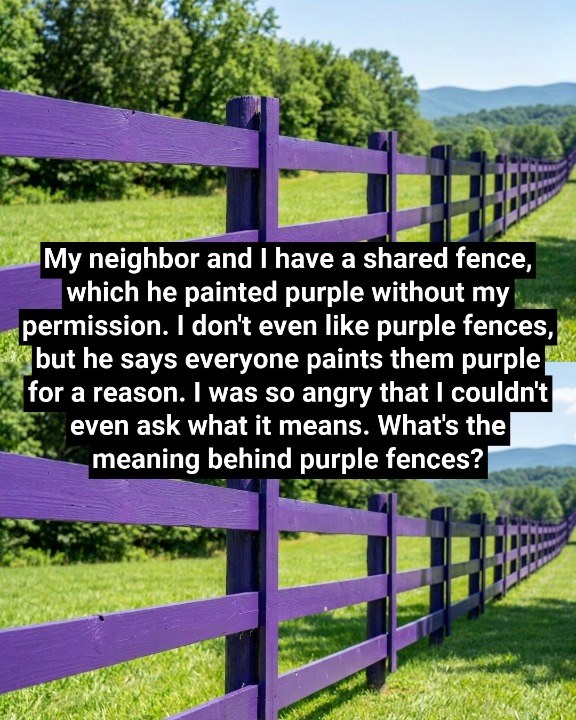
In many states, a purple painted fence or tree is the official equivalent of a “No Trespassing” sign.
And ignoring it could lead to criminal charges.
Known commonly as the Purple Paint Law, this growing legal practice has expanded across numerous states in recent years, including Texas, Missouri, Arkansas, and Illinois. Instead of relying entirely on traditional posted warning signs, landowners can legally mark property boundaries using highly visible purple paint.
The idea was born out of frustration.
For decades, property owners depended on metal or plastic “No Trespassing” signs to protect private land. But those signs often created constant problems. They were stolen, vandalized, damaged by weather, or even used as target practice. Replacing them repeatedly became expensive and time consuming.
Purple paint offered a much more durable solution.
Unlike signs, paint cannot easily be removed, blown away, or ignored after repeated exposure to harsh weather conditions. A single can of specially designed paint can mark property boundaries for years at a fraction of the cost.
But these markings are not random splashes of color.
Most states with Purple Paint Laws have very specific legal requirements regarding how the markings must appear. Typically, the paint must form vertical stripes approximately one inch wide and at least eight inches long. The markings usually need to be placed between three and five feet above the ground and repeated regularly along property lines or entry points.
Once those legal standards are met, the markings officially serve as a clear warning that private property begins there.
Crossing beyond them without permission may legally qualify as trespassing.
The choice of purple itself was not accidental either.
Experts say purple stands out strongly in natural environments where greens, browns, and grays dominate the landscape. It also remains visible during low light conditions such as dawn and dusk when hikers and hunters are most active. In addition, purple is considered distinguishable for many people with certain forms of color blindness, making it an effective universal warning color.
For outdoor enthusiasts, hunters, campers, and hikers, understanding these markings has become increasingly important.
Legally speaking, crossing a purple-marked boundary is treated much differently than accidentally wandering into an unmarked field. In states recognizing Purple Paint Laws, those markings carry the same legal authority as traditional warning signs or locked gates.
That means someone who ignores the markings could face criminal trespassing charges, fines, court appearances, or even misdemeanor records depending on the situation and local laws.
In more serious circumstances involving weapons, repeated violations, or refusal to leave private property, the legal consequences can escalate significantly.
Legal professionals warn that many people unknowingly assume rural or wooded land is public simply because there are no fences or posted signs nearby. But under Purple Paint Laws, the paint itself is considered sufficient notice.
And claiming ignorance rarely works as a legal defense.
The growing popularity of these laws also reflects larger cultural tensions surrounding land ownership and public access. As outdoor recreation becomes more popular and rural development expands, many private landowners feel increasing pressure from trespassing, littering, hunting violations, vandalism, and liability concerns.
For many homeowners and ranchers, purple paint has become a practical way to protect privacy, safety, and property rights without constantly replacing damaged signs.
In some rural communities, the markings have even taken on symbolic meaning. A purple fence often signals that the owner takes property boundaries seriously and fully intends to enforce them legally if necessary.
Experts strongly encourage travelers, hikers, hunters, and outdoor enthusiasts to research local regulations before entering unfamiliar land, especially when crossing state lines. Not every state recognizes Purple Paint Laws, and the exact requirements can vary from one jurisdiction to another.
Still, the general advice remains simple.
If you see purple markings on trees, fences, or posts, stop immediately unless you have clear permission to continue.
What may appear to be harmless paint could actually represent a legally protected property boundary carrying serious consequences.
As more states continue adopting Purple Paint Laws heading into 2026, legal experts believe public awareness will become increasingly important. The system’s simplicity is part of what makes it so effective. A low-cost bucket of paint can legally secure thousands of acres with far greater permanence than traditional signage.
So the next time you spot bright purple stripes deep in the woods or along a remote trail, do not dismiss them as random decoration or graffiti.
They are a warning.
And in the eyes of the law, that warning can be just as powerful as a locked gate or a written legal notice.