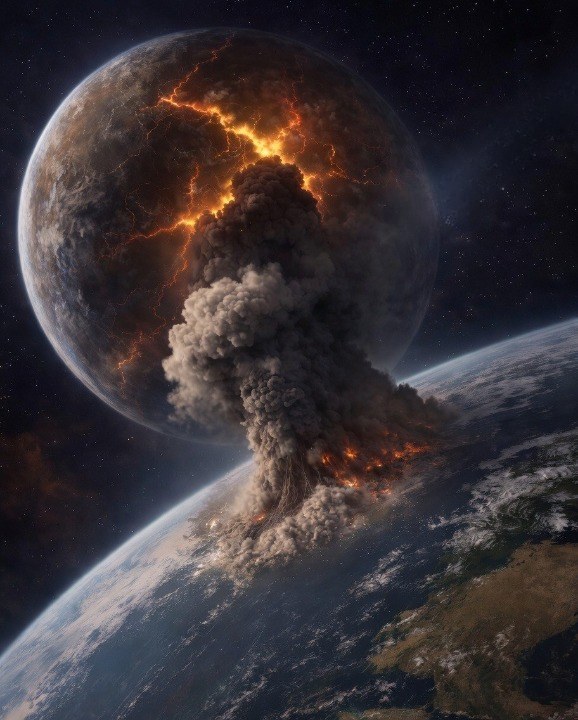
Far beyond the warmth of Earth and hidden inside the freezing darkness of space, an enormous object is racing silently through the solar system.
Its official designation is 52768 (1998 OR2).
The name sounds cold and technical, almost forgettable, but the object itself is anything but ordinary. To scientists monitoring the skies, this asteroid represents one of the most powerful natural threats humanity could ever face. While the public often imagines asteroid disasters as scenes from science fiction films, experts know the danger is very real.
And objects like 1998 OR2 are the reason planetary defense programs exist at all.
At first glance, the asteroid may appear insignificant compared to the vast emptiness of space. Yet estimates place its size somewhere between 1.5 and 4 kilometers wide, making it large enough to qualify as a potential civilization-ending object under the wrong circumstances.
To truly understand the scale, imagine a mountain hurtling through space at incredible speed.
That is essentially what this asteroid is.
NASA and astronomers around the world have spent years carefully tracking its orbit, measuring its rotation, and analyzing every movement with extraordinary precision. The asteroid is currently traveling at approximately 8.7 kilometers per second, or more than 19,000 miles per hour.
At those speeds, even a relatively small orbital deviation could carry catastrophic consequences.
Fortunately, current calculations show no immediate danger of impact.
According to scientists monitoring the object, 1998 OR2 is expected to pass Earth safely during its closest approach. Space agencies continue emphasizing that there is no known collision threat connected to this flyby.
Still, the asteroid has triggered renewed discussions about a deeply uncomfortable reality.
Humanity remains far less prepared for a true planetary threat than most people realize.
If an asteroid this size ever struck Earth directly, the devastation would be almost unimaginable. The impact would unleash energy equivalent to thousands of nuclear explosions occurring simultaneously. Entire coastlines could vanish beneath tsunamis. Massive fires would ignite across continents. Dust and debris would rise into the atmosphere blocking sunlight for months or even years.
Agriculture would collapse.
Global temperatures could plummet.
Modern civilization itself might not survive intact.
And while experts reassure the public that 1998 OR2 will miss Earth, many scientists quietly acknowledge that our safety depends heavily on early detection and a substantial amount of luck.
That is the part many people overlook.
We are safe this time because astronomers found the asteroid years in advance and had enough time to calculate its trajectory accurately. But if a similarly dangerous object emerged suddenly from one of space’s observational blind spots, humanity would face a far more terrifying scenario.
Current asteroid defense technology is impressive but still limited.
NASA’s recent DART mission successfully altered the orbit of a small asteroid using a kinetic impact test, proving that changing an asteroid’s path is theoretically possible. However, redirecting a giant multi-kilometer object like 1998 OR2 would be dramatically more difficult.
The difference between nudging a smaller rock and diverting a mountain-sized asteroid is enormous.
And that reality has many experts concerned.
The flyby of 1998 OR2 serves as a reminder that Earth exists inside a chaotic cosmic environment filled with fast-moving debris left over from the formation of the solar system. Thousands of smaller near-Earth objects remain undetected, particularly those approaching from directions obscured by sunlight or deep-space darkness.
Astronomers refer to these hidden regions as “blind spots.”
And those blind spots are one of the greatest vulnerabilities in planetary defense systems.
What makes this situation even more complicated is the human element.
A true asteroid emergency would require unprecedented international cooperation. Rival nations would need to share classified technology, coordinate space missions, and agree on a unified strategy under intense pressure.
In many ways, a planetary threat exposes how fragile global unity truly is.
Asteroids do not care about politics, borders, or military alliances.
A sufficiently large impact would affect everyone equally.
That realization has transformed objects like 1998 OR2 into more than just scientific curiosities. They have become reminders of how interconnected humanity really is when faced with dangers beyond Earth itself.
As the asteroid approaches its closest flyby, observatories around the world will focus telescopes toward the sky gathering data about its composition, surface structure, and origin. Scientists view moments like this as rare opportunities to study ancient remnants from the birth of the solar system.
These objects are essentially time capsules older than Earth’s modern continents.
For the average person, however, the event may barely register beyond a passing headline online.
Yet behind the scenes, planetary defense experts are paying extremely close attention.
Because while this asteroid will pass harmlessly by, another one eventually may not.
That possibility is exactly why researchers continue pushing for stronger investment in infrared telescopes, advanced radar systems, and future asteroid deflection technologies. Every close encounter teaches scientists more about how to detect, track, and potentially stop dangerous objects before disaster strikes.
The good news is simple.
The current calculations are solid.
1998 OR2 is not expected to hit Earth.
But the larger lesson remains impossible to ignore.
Humanity survives partly because of science and preparation, but also because the universe has not yet forced us into a true planetary emergency.
The margin between safety and catastrophe can sometimes be measured by tiny orbital differences invisible to the human eye.
As this enormous asteroid races past our planet, it serves as a powerful reminder that Earth is not isolated from cosmic danger. We live inside an active solar system where massive objects constantly move through darkness at extraordinary speeds.
The real challenge begins after the flyby ends.
Will humanity continue investing in planetary defense while there is still time?
Or will we wait until a future object gives us less warning and far fewer options?
For now, 1998 OR2 will remain only a distant visitor passing silently through space.
But its presence forces us to confront an uncomfortable truth.
The universe is unpredictable.
And somewhere beyond the darkness, the next object is already moving.