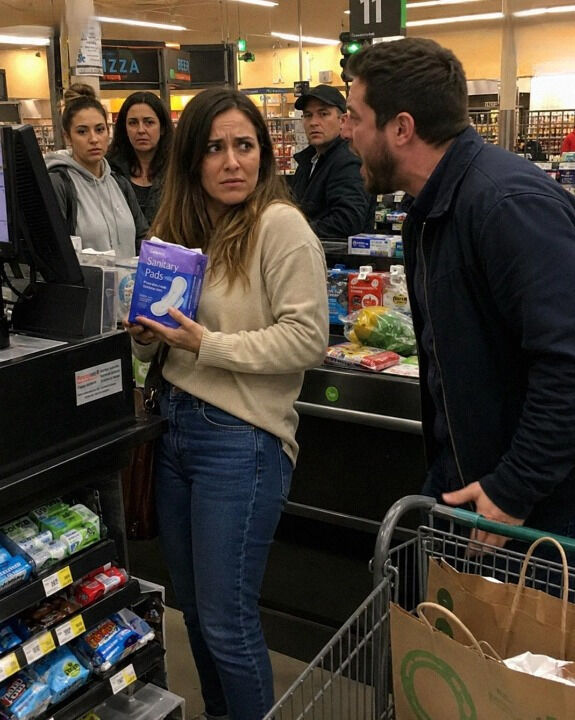
My lower back felt like it was being squeezed by an invisible metal band, tightening with every passing minute. The cramps had started early that morning and only grew worse as the day went on, turning a simple grocery trip into something exhausting. All I wanted was to get through the checkout, go home, change into comfortable clothes, and curl up under a heating blanket.
But as we reached the register and the cashier began scanning our items, I felt a sudden wave of panic. I reached into my bag, digging past keys, receipts, and lip balm—only to realize my wallet was still sitting at home on the kitchen counter.
I picked up the small six-dollar pack of pads from the conveyor belt and leaned toward my husband, Ashton, quietly asking if he could pay for them.
He paused his scrolling, glanced at the box, and spoke loudly enough for everyone nearby to hear. He said he wasn’t paying for my “little wants” and that I was a grown woman who should handle my own personal needs.
The cashier stopped mid-scan. A woman behind us raised her eyebrows. Heat rushed to my face, and rather than cause a scene, I asked the cashier to remove the item.
What made it worse was everything that had come before.
Just a year earlier, Ashton had been unemployed for eight long months. During that time, I carried everything. Rent, bills, groceries, gas, even new shoes for his interviews. I never once called his needs “little wants.”
We drove home in silence. He tapped the steering wheel, completely unaware of what he had just done.
Once inside, he casually leaned against the counter and announced that from now on, everything would be split fifty-fifty. Equal in every way.
I looked around—the dishes he hadn’t washed, the laundry he hadn’t folded, the responsibilities he ignored.
Then I smiled and agreed.
He had no idea what he had just signed up for.
Over the next few days, I followed his rule exactly. I paid half the rent. I cooked meals—but only for myself. I cleaned only what I used. I bought groceries just for me.
On the third morning, he opened the pantry and asked where the coffee was.
I calmly told him I had bought my half. His half was still at the store.
He laughed at first—until he realized I was serious.
By the second week, our apartment felt like a quiet standoff. His laundry piled up, his dishes stayed dirty, while my side remained perfectly in order. He grew frustrated, opening the fridge only to find everything labeled with my name.
“Are you still doing this?” he snapped.
“You wanted fifty-fifty,” I replied.
Instead of understanding, he mocked me again days later, asking if I was still upset over “a simple box of pads.”
That’s when I knew.
He wouldn’t learn privately.
So he would learn publicly.
His birthday gave me the perfect opportunity.
I offered to host a party. I cleaned the apartment, ordered high-quality food, decorated everything. I invited his friends, coworkers, and even his boss, Derrick, who showed up with an expensive bottle of whiskey.
Ashton was thrilled, proudly telling everyone how lucky he was to have me.
Later that evening, I brought out the cake—a large, beautifully decorated chocolate centerpiece. I told him there was a special surprise inside and that he should cut into the middle.
Everyone gathered around.
He smiled, picked up the knife, and sliced into it.
Then he stopped.
Right in the center of the cake sat a brightly colored plastic box—a children’s educational kit about menstrual cycles.
The room went silent for a second before laughter started breaking out.
He stared at it, confused and embarrassed. I told him to open it.
Inside was a doll, tiny pads, and a simple guide explaining basic biology.
His face turned red.
I turned to the room and explained calmly that since my husband believed women could control their cycles, I thought it was time he learned how things actually worked.
The women burst into laughter. The men looked stunned.
I took it a step further.
I turned on the TV and played an educational video explaining menstrual health.
The room erupted. People laughed, some even recorded the moment. Conversations broke out, stories were shared, and suddenly the tension turned into something else entirely.
Ashton sat there, holding the doll, completely humbled.
I paused the video and told him I hoped he enjoyed his gift—and that I trusted my “little wants” wouldn’t be questioned again.
He sighed, admitted he deserved it, and the night slowly settled.
After everyone left, he came into the kitchen where I was washing glasses.
He apologized sincerely. He said he hadn’t realized how selfish he had been until he saw it from the outside.
The next day, he came home with a pharmacy bag. Inside were the exact pads I needed, along with chocolates, heating patches, and snacks.
He admitted he didn’t know what to buy, so he got everything that looked helpful.
From that moment, things changed.
He stopped keeping score. He started contributing without being asked. And now, whenever he heads out, he always asks if I need anything.
I always smile and ask, “Are my little wants included?”
He just grabs his keys, smiles back, and says they always will be.