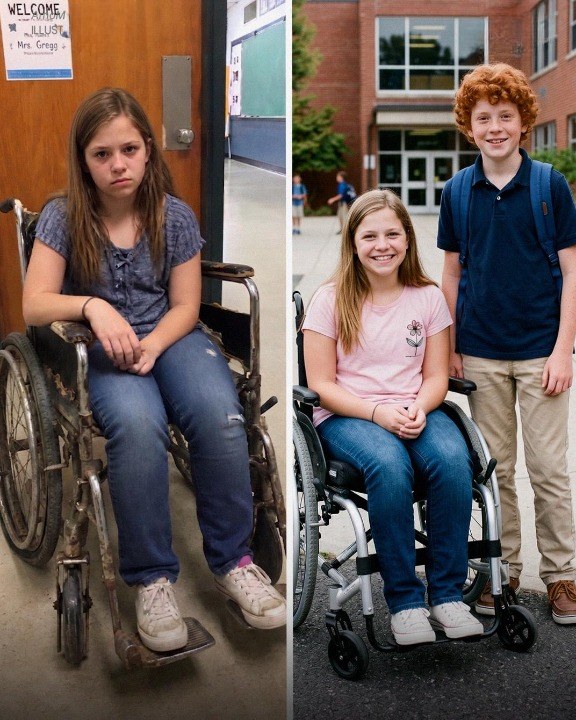
I assumed the police had shown up because my son had done something wrong. What I didn’t expect was that their visit would reveal something far more powerful: that even the quietest act of kindness can leave a lasting impact on everyone who witnesses it.
The morning the officers knocked on my door, I was certain my son was in trouble.
That was my first mistake.
My second was thinking I already understood everything a few days earlier, when I stepped into David’s room carrying laundry and noticed something missing.
His guitar was gone.
“David?” I called out.
“Yeah, Mom?” he answered from the kitchen.
“Where’s your guitar?”
He appeared in the doorway, hesitating. “Mom… I’m sorry I didn’t tell you…”
“David, what happened?”
He lowered his eyes. “I sold it.”
“You sold it?”
I dropped the laundry basket, my hands suddenly weak. “Why would you do that? That guitar meant so much to you.”
He swallowed hard. “It did. But Emily needed a new wheelchair.”
I just stared at him.
“Her old one barely worked,” he rushed to explain. “The wheels kept sticking. She acted like it was fine, but it wasn’t. She even skipped lunch twice last week because she couldn’t get across the school fast enough.”
I tried to interrupt, but once he started, he couldn’t stop.
“Her family doesn’t have the money right now,” he added quietly. “So… I sold the guitar.”
I sat down on the edge of his bed without realizing it.
Emily was his classmate. A kind girl with thoughtful eyes and a constant book in her lap. I knew she had been paralyzed when she was younger, but I had no idea her situation had gotten that bad.
“How did you even manage this?” I asked.
“I posted the guitar online,” he said. “Mr. Keller from church bought it.”
I blinked. “You sold an expensive guitar to an adult without even telling me?”
“He asked me like four times if I was sure.”
“David…”
“I was sure, Mom. I still am.”
I pressed my fingers to my forehead. He was so sincere it made me want to cry and scold him at the same time.
“Why didn’t you come to me first?”
He looked miserable. “Because you’d try to fix it the practical way. Emily didn’t have time to wait. She needed help now.”
That hit me hard, because he was right.
I was the kind of person who planned everything carefully, stretched every dollar, and solved problems step by step. My son had skipped all of that and gone straight to sacrifice.
“Did you at least get a fair price?” I asked.
“Kind of.”
“That’s not an answer.”
“I asked for $1200 and got $850. But it was enough. I ordered the wheelchair through the hospital. It’s already paid for.”
I closed my eyes. The guitar had cost more, but not by much. This wasn’t careless—it was thought through.
“Mom?”
I opened my eyes and saw him watching me carefully, unsure what was coming next.
“Are you mad?”
“I’m shocked,” I said honestly. “And proud. But also a little upset that you made such a big decision without talking to me.”
He nodded quickly. “That’s fair.”
I reached out my arms. “Come here.”
He hugged me, awkward and lanky, and I felt my frustration melt into something deeper.
“You’re too much like your father,” I murmured.
“Is that a good thing or a bad thing?” he asked.
“Today? A little inconvenient… a little expensive… but very good.”
He smiled.
The next morning, he made me tea and asked if we could pick up the wheelchair.
“It’s ready,” he said. “Can we bring it to Emily? I didn’t tell her. I want it to be a surprise.”
“What about her parents?” I asked. “Won’t they feel uncomfortable?”
“I don’t think so,” he said. “They couldn’t help her. I just did.”
We went.
Emily opened the door in her old chair and froze when she saw us.
“What’s that?” she asked.
David glanced at me, then back at her. “It’s for you. A new wheelchair.”
Her expression broke instantly.
Her mother came behind her, then stopped too.
David nearly dropped the box as he set it down. “Your chair wasn’t working right,” he said nervously.
Emily’s eyes filled with tears. “You bought me a wheelchair?”
I answered quietly, “He sold his guitar.”
Her mother covered her mouth.
“Why would you do that?” Emily asked, overwhelmed.
David shrugged. “Because you needed it.”
Her father, Nathan, came into the hallway just then. He looked from the box to Emily to David, trying to make sense of everything.
“Your son sold something he loved… for my daughter?” he asked.
“Yes, sir,” David said softly.
Nathan swallowed hard. “Thank you.”
That should have been the end of it.
But it wasn’t.
The next morning, someone pounded on our door so hard it shook the frame.
Two police officers stood outside.
“Ma’am, are you Megan?” one asked.
My throat went dry. “Yes.”
“Is your son home?”
My stomach dropped. “Why? What happened?”
Before they answered, David came into the hallway behind me.
“Ma’am,” the officer said, “are you aware of what your son did yesterday?”
My hand gripped the doorframe. “What’s going on?”
“He’s not in trouble,” the officer added quickly.
That didn’t calm me.
“Then why are you here?”
“Because what he did reached people,” the second officer said. “Someone wants to thank him.”
I turned to David. He looked just as confused as I felt.
We stepped outside.
A patrol car was parked nearby, and next to it stood Nathan, looking exhausted.
We followed them to his house.
Inside, Emily and her mother were waiting. A full breakfast was laid out.
And there, leaning against the wall, was a brand-new guitar case.
David froze.
Nathan rubbed his face. “Yesterday I learned how much my daughter had been hiding… and that a thirteen-year-old boy gave up something he loved because he couldn’t stand seeing her struggle.”
David shrugged again. “She needed it.”
Nathan nodded. “I told the officers at work what you did. Every one of them contributed.”
The officer tapped the case. “We all pitched in for you.”
Nathan’s voice cracked. “I thought I was taking care of my family. Meanwhile, my daughter was struggling… and your son saw what I didn’t.”
David shook his head. “You didn’t have to do this.”
“Yes,” Nathan said firmly. “I did.”
Emily rolled up beside him in her new chair. “And you’re not selling this guitar, got it?”
David smiled. “No promises.”
“David!”
“Alright, alright. I’ll keep it.”
I stood there, taking it all in—the officers, the breakfast, Emily’s smile, Nathan’s gratitude.
I had been terrified the police were there because my son had done something wrong.
Instead, they came because he had reminded a room full of adults what doing the right thing actually looks like.
Later that day, I found him sitting on his bed, gently strumming the new guitar.
“Well?” I asked.
“It’s really nice,” he said softly.
“That’s more than nice.”
He smiled, still a little in disbelief.
What stayed with me wasn’t the gift.
It was the way his simple act of kindness had quietly changed everyone around him.