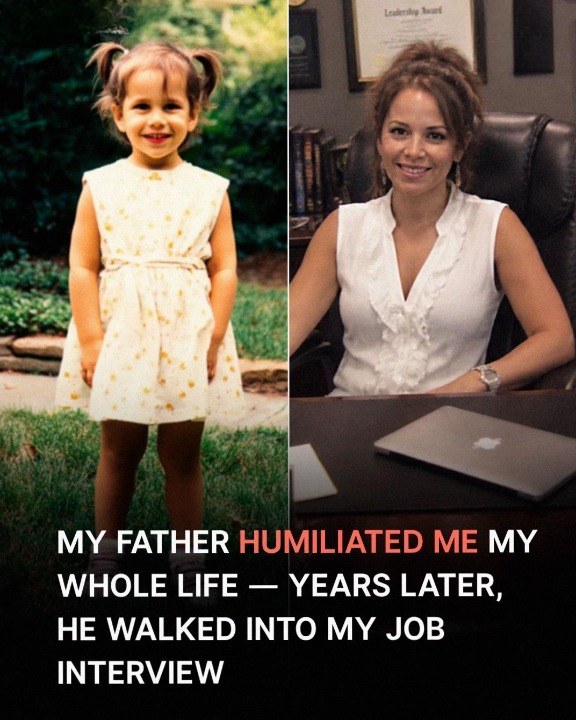
For years, Ava carried one sentence inside her like a bruise she couldn’t stop pressing: her father’s warning that she would end up with nothing. Then, on what should have been just another routine hiring day, fate placed him in the waiting area of a company he never believed she could build.
I grew up under relentless pressure from him.
“You have to do better.”
“That’s not enough.”
“Follow my path, or you’ll have nothing.”
My father worked in construction and believed his way was the only way. Not just the trade itself, but his version of it.
His standards. His temper. His belief that respect came from being tougher than everyone else and showing no softness at all. He believed harshness created strength. Maybe it worked for him. But for me, it created distance.
Nothing I did was ever enough.
If I brought home good grades, he questioned why they weren’t better. If I picked things up quickly on one of his job sites, he pointed out my mistakes before I even had time to feel proud. If I pushed back, I was stubborn. If I stayed quiet, I was weak. There was no version of me he could accept without seeing flaws.
And he made sure I knew exactly what would happen if I didn’t become what he wanted.
“You’ll end up with nothing.”
He repeated it so often that, for a while, I believed him.
My mother tried to soften things, in the quiet, exhausted way people do after years of smoothing over someone else’s sharp edges. But you can’t shield a child from a parent’s voice when that voice defines the entire atmosphere of the home.
Then one day, he crossed a line.
“You’re an embarrassment,” he said.
I was seventeen.
I don’t even remember what triggered it. Maybe I argued. Maybe I hesitated. Maybe he just needed someone smaller to carry the weight of his anger. It didn’t matter anymore.
After that, I stopped trying to earn his approval.
Eventually, I left that house. Not long after, my parents divorced, and he disappeared. For years, no one knew where he went or what became of him.
And I started over.
That phrase sounds simple, but it wasn’t. Starting over at that age meant struggling, working wherever I could, carrying his voice in my head even when he was gone.
I took whatever jobs I could find.
Office work. Cleaning job sites after hours. Anything that paid.
Eventually, I moved closer to the work I wanted.
Construction had become part of me, whether I liked where it came from or not.
Small jobs turned into bigger ones. A small crew turned into something stable. Then, slowly, I built my own construction and renovation company.
It took years. Bad contracts. Long drives. Cheap coffee. There was even a winter when I thought everything would fall apart after two clients delayed payment at the same time.
But there was something my father never understood about me.
I’m stubborn in quiet ways.
I don’t always fight loudly. I endure.
By twenty-four, I had a real office, a strong team, and a reputation people trusted with major projects.
That day, I was waiting for an important candidate. Someone experienced enough to manage large developments.
We were growing fast, and growth without the right people can destroy everything. I needed someone who understood the work.
On paper, the candidate looked solid.
Years of experience. Strong background. But there were gaps too.
I was reviewing his file when Lena, our receptionist, called.
“The candidate is here.”
I stepped out—and froze.
It was him.
My father.
He looked older. Worn down. But his voice hadn’t changed.
“I need this job. It’s my last chance. I can’t end up with nothing.”
He saw me—and there was no warmth.
“If you think you can take my place in this interview, don’t even try,” he said. “You’d better leave.”
Lena looked confused. Mason, who had just walked out of the conference room, stopped mid-step.
I said nothing.
I turned and walked back to my office.
I needed a moment to steady myself.
A few minutes later, the door opened. He walked in.
“What are you doing here?” he snapped. “Get out.”
“I can’t,” I said calmly.
“Why not?”
I met his eyes.
“Because this is my company. And this is my office.”
I watched everything he believed about me collapse in real time.
I leaned forward slightly.
“Here’s what we’re going to do, Dad.”
He just stood there, staring like the room itself had betrayed him.
I let the silence sit between us.
When I was younger, silence belonged to him. He used it to make me uncomfortable until I filled it with explanations.
Now, it belonged to me.
My name was on the glass outside. My plans covered the walls. My team treated me with quiet respect.
He finally sat down.
“This is some kind of joke,” he muttered.
“No. It’s an interview.”
His jaw tightened.
“You did all this?”
“Yes.”
He looked around again, trying to process it.
Mason stepped in briefly and handed me the file. No hesitation. No doubt.
That moment mattered.
My father had always believed authority had to be loud. Seeing quiet respect unsettled him more than anything else.
I opened the file and treated him like any other candidate.
Experience. Work history. Gaps. Reasons for leaving jobs.
Some answers were solid. Others evasive.
Then I closed the file.
“I can offer you the job.”
His head snapped up.
“But there’s a condition.”
His expression hardened.
“Of course there is.”
I folded my hands.
“If you work here, you acknowledge two things. First, I built this company. Second, you were wrong about me.”
He stared at me.
“And I want to hear you say you’re proud of me.”
He let out a short, humorless laugh.
“So this is revenge?”
“No,” I said. “This is truth.”
He leaned back.
“You think because you have an office and a title, you get to lecture me?”
“No. I think because you need this job, and this is my company, I decide who I hire.”
That silenced him.
After a long pause, he said, “I need the job.”
“That wasn’t the condition.”
He looked away.
For a moment, I thought he’d walk out.
Instead, he said, “I’ll take the job.”
I nodded.
“You’ll start under Mason. Standard probation.”
“Mason?” he repeated.
“Yes.”
That one hit him hard.
The first few weeks were tense.
Not because he didn’t know the work. He did.
But now he had to listen. Take direction. Accept leadership from people he would’ve dismissed before.
He watched how I ran things. How clients trusted me. How the team respected me.
Reality did what arguments never could.
Slowly, he changed.
Small things at first. Asking instead of challenging. Offering input instead of overriding.
Mason noticed it too.
“He’s trying,” she told me.
I knew.
The real shift came quietly.
One evening, he knocked on my office door.
“You were right,” he said.
I stayed silent.
“I was wrong about you.”
He looked down, then back at me.
“I thought I was preparing you. But I wasn’t. I was wrong.”
He paused.
“And I’m proud of you.”
No dramatic moment. No perfect apology. Just something real.
It landed harder than anything else ever could.
I nodded.
A month later, I promoted him.
Not out of pity.
Because he earned it.
For the first time, I didn’t have to prove anything.
He chose to see it.