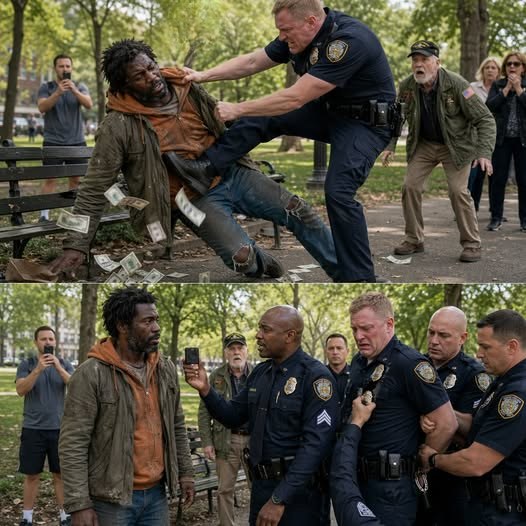
The air in Morrison Park carried the smell of wet soil mixed with exhaust fumes, but for nearly a week, I had been living with something far worse. I hadn’t showered, hadn’t slept properly, and hadn’t been seen. That was the entire point. Wrapped in a worn-out blanket, blending into the background like just another forgotten man, I had erased myself on purpose.
To everyone else, I was invisible.
To Officer Walsh, I was something else entirely.
He didn’t react right away when I spoke. My words hung there between us, almost unreal in the cold morning air. His hand tightened around my collar, pulling me closer. I could see every detail in his face, the strain in his eyes, the quiet certainty of a man who believed nothing could touch him.
He leaned in and asked me to repeat what I said, his voice low and controlled. It wasn’t curiosity. It was a warning.
I coughed slightly, buying myself a moment. Beneath the rough fabric of the blanket, a tiny camera stayed fixed, capturing everything. Every flicker of emotion. Every shift in expression. I repeated myself calmly.
I told him Internal Affairs had been watching him.
That changed everything.
Behind him, Officer Carter stiffened. Officer Lopez stopped mid-step. The confidence that usually surrounded Walsh began to fracture. For a split second, the truth slipped through.
Then he snapped back into control.
He shoved me hard, sending me to the ground, and shouted that I was resisting. It was automatic, like muscle memory. The kind of move meant to justify whatever came next. He turned toward the few people nearby and barked orders for them to step back.
I stayed down, playing the role I had lived for six days.
He reached for his cuffs, movements sharp and restless. When he ordered me to put my hands behind my back, I didn’t respond. Instead, I reached slowly inside my coat.
His posture shifted instantly, tense, ready. But I moved deliberately, calmly. I pulled out my badge.
The gold caught the sunlight, flashing across the dirt.
I introduced myself.
Captain Jonathan Rivers. Internal Affairs.
Everything went quiet.
The kind of silence that feels heavy in your chest.
Walsh stared at the badge, then at me, then back again. The realization came slowly, like something he didn’t want to accept. He tried to laugh it off, said it had to be a joke.
I pointed to the blanket.
I told him about the cameras.
Three angles. Clear footage. Streaming in real time.
For six days, I had watched him.
Monday, he threatened a man who had nowhere else to go.
Tuesday, he destroyed what little someone owned because it annoyed him.
Wednesday, he pushed an older man to the ground without hesitation.
And that morning, he kicked me in the ribs and told me to crawl.
As I spoke, his posture changed. The arrogance drained away, replaced by something raw. He tried to justify it, saying I didn’t understand how things worked, that people like that lied.
I told him they were still people.
That was enough.
I called it in.
I wanted it handled properly. No shortcuts. No excuses.
The sound of sirens grew louder, cutting through the quiet of the park. Officer Lopez stepped forward to place Walsh under arrest. There was a different energy in him now, like something had finally snapped into place.
The cuffs clicked shut.
That sound said everything.
When the supervisor arrived, it was already over. Walsh was taken away without a fight, his eyes lingering on the bench as if seeing it for the first time. For years, it had been a place where he exercised control. Now, it was evidence.
Carter and Lopez came over afterward, their voices low, heavy with what they hadn’t done. They tried to explain why they stayed quiet.
I didn’t let them off easy.
This wasn’t just about one officer. It was about the silence that allowed him to keep going. They understood. They said they would give full statements.
They knew they had been seen too.
As I stood there brushing off the dirt, I noticed a jogger still nearby, holding a phone. He admitted he almost walked away.
I told him staying mattered.
Because power shows its real face when it thinks no one is watching. It grows in places where people feel invisible.
Walsh thought he owned that space.
He thought no one would ever see.
But he was wrong.
The case wasn’t going to be complicated. It didn’t need to be. It was decided the moment he chose to hurt someone he believed didn’t matter.
Later that night, back at the office, I watched the footage again. Every moment. Every choice.
The badge didn’t give me the power to stop him.
That came from something else entirely.
It came from sitting in the dirt. From seeing what he saw every day and refusing to look away.
He thought he was untouchable because of his position.
But the truth was simple.
He never noticed the one person who disappeared completely.
And that’s why he never saw it coming.