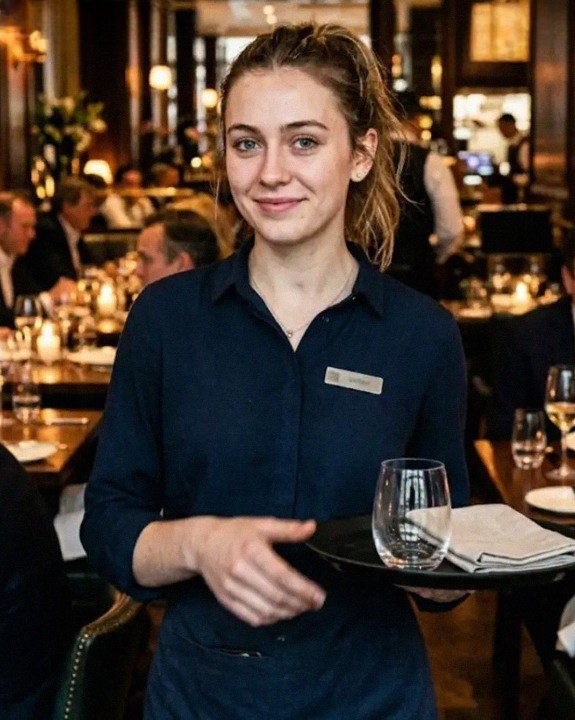
I left a $100 tip for a waitress who looked like she was barely holding it together, thinking it was just a small gesture. But when I got home and found an envelope in my takeout bag, everything shifted. What was inside made it clear she was dealing with something serious, and I knew I couldn’t just ignore it.
I work long hours under constant pressure. The money is good, but more than that, the job keeps me from sitting still with my thoughts for too long.
Most nights, I stop by the same upscale restaurant downtown. It’s not just about the food. It’s a buffer between work and home, a place where silence doesn’t feel so empty.
That night, I arrived a little after nine. The dinner rush was slowing down but hadn’t completely faded.
When the waitress approached my table, I noticed the dark circles under her eyes immediately. She smiled, stayed polite, but it was obvious she was exhausted.
At the time, I thought it was just a long shift. I had no idea how much more she was dealing with.
“What can I get for you tonight, sir?” she asked. “The chicken schnitzel? Or maybe the cordon bleu?”
“Am I really that predictable?” I said.
She shook her head lightly. “I just pay attention to what our regulars like.”
I wasn’t especially hungry, but I ordered anyway.
It was something small, just being recognized, but it felt good. Maybe that’s why I started paying closer attention to her.
From the corner of my eye, I watched her handle everything—an impatient table next to me, a mistake from the kitchen, constant movement without a break. She worked like stopping wasn’t an option.
When she brought my check, I added a few extra items to take home.
The bill came out to just over $50. I left $100 on top of it.
When she saw it, she paused, blinking once.
Then she looked at me and said quietly, “Thank you.”
I shrugged, unsure how to respond, and waited near the front for my takeout. She disappeared into the kitchen, then returned with my bag.
“Have a good night,” she said.
“You too.”
Two hours later, I was home, finally alone in the quiet.
I opened the bag before putting everything away and immediately noticed something off.
There was an envelope sitting on top of the containers.
It didn’t belong there.
I stared at it for a moment, assuming it had slipped in by accident while she packed my order.
I should have left it alone.
Instead, I opened it.
Inside was a thick stack of cash. At least a thousand dollars, maybe more.
There was also a note.
“I know it’s not the full amount, but this is everything I have. I’m sorry, but I can’t keep doing this anymore.”
I read it twice, trying to come up with any normal explanation for it.
There wasn’t one.
The more I thought about it, the clearer it became that she was in some kind of trouble.
I stood there in my kitchen with the strange feeling that I was holding someone else’s future in my hands.
I could have ignored it. That would have been easier.
Or I could take it back.
What finally pushed me to act wasn’t some sudden sense of heroism. It was something else—I was tired of watching life from a distance, like it was happening somewhere else.
So I grabbed my keys, slipped the envelope into my jacket, and drove back.
It was nearly midnight when I walked into the restaurant.
A manager approached me right away. “Sorry, sir, we’re closing.”
I held up the envelope. “I was here earlier. The waitress—table twelve—this ended up in my takeout by mistake.”
“Maya?” he said, glancing toward the kitchen. “She left early tonight. Said she had something important to handle.”
Something in his tone made me uneasy.
“Do you know where she went?” I asked.
He shook his head. “Even if I did, I couldn’t share that. Leave it with me, I’ll make sure she gets it.”
I hesitated. I probably should have agreed.
But the note kept running through my mind.
“I know it’s not the full amount…”
If she was in trouble, waiting until tomorrow might be too late.
As I turned the envelope over, I noticed something faint on the back—an address, partly smudged.
I looked at it for a moment.
“I’ll come back tomorrow,” I told the manager.
But I didn’t.
I drove to the address instead.
It was about fifteen minutes away, on the edge of a neighborhood that had seen better days.
I parked and turned off the engine.
Before I stepped out, I heard voices.
A man’s voice first, sharp and demanding.
“You said you had it.”
Then hers—tight, anxious.
“I did, but it’s gone. I don’t know how.”
I got out quietly and followed the sound.
They stood outside a ground-floor apartment, the door half open.
Maya had changed into a sweatshirt and leggings. The man facing her looked tense and angry.
“I was counting on you,” he said. “You can’t just do this. I need that money.”
“I told you, it’s gone,” she snapped. “You think I planned that?”
“I think you’re lying. Now give it to me.”
He stepped closer.
She didn’t move.
“I’m not lying,” she said. “And honestly, the more we talk, the more I’m glad it’s gone.”
“How can you say that?” he shot back. “Do you know what kind of trouble I’m in? My utilities are about to get shut off.”
“That’s because of your choices,” she said. “You had money. You spent it on a PlayStation. You were counting on me to fix it again.”
“So you’re just going to let your own brother struggle?” he snapped.
She crossed her arms. “Being family doesn’t mean I clean up every mess you make.”
He stepped closer again, lowering his voice. “Stop playing games. Give me the money.”
That’s when I stepped forward.
“I have it.”
They both turned toward me.
Maya’s eyes went straight to the envelope in my hand. “I must’ve dropped it when I packed your order,” she said quietly.
The man held out his hand. “Perfect. Hand it over.”
“No,” I said.
I looked at Maya. “I came to return it. But after hearing all this… if you give it to him, nothing changes.”
He scoffed. “This isn’t your business.”
Maya didn’t speak. She just watched me.
He stepped toward me. “Last chance. Give it here.”
A door nearby opened slightly. Then another. People were watching now.
The tension shifted.
I held the envelope out to Maya. “It’s yours. What you do with it is your choice.”
She took it.
He reached for it, but she pulled it back and slipped it into her bag.
“I told you I’m done,” she said.
Then she walked past him.
He called after her, angry, desperate.
She stopped for a moment, then turned back.
“I can walk away,” she said. “I just never did before.”
Then she kept going.
He stood there, frustrated, looking for someone to blame, but the moment had already passed.
I headed back to my car.
She stood near the curb, arms wrapped around herself, staring into the distance.
“You didn’t have to come back,” she said without looking at me.
“I know,” I said. “But I thought you might need help.”
That made her look at me.
“Thank you,” she said quietly. Then she walked away.
I sat in my car for a moment, thinking.
For years, I had built my life around staying detached—from people, from problems, from anything that might pull me in.
But standing there, hearing her say she could walk away, I realized something I had been avoiding.
Keeping your distance isn’t peace.
It’s just another way of leaving before anything can ask something of you.
That night asked something of me.
And for once… I didn’t walk away.