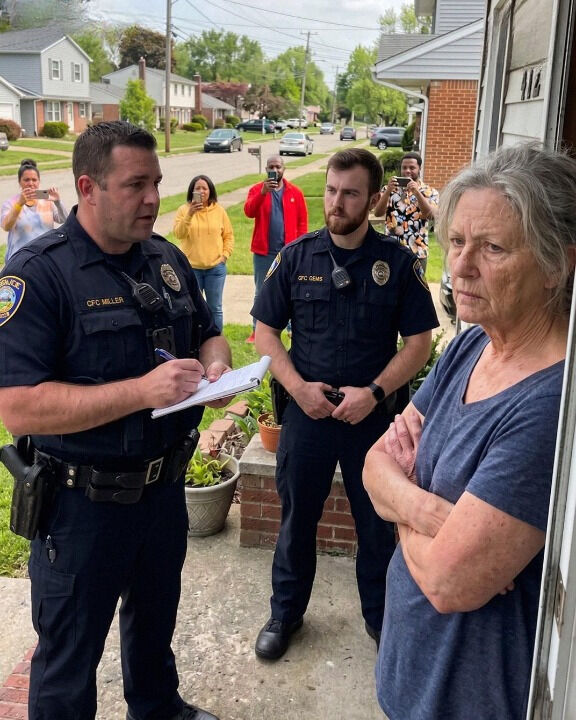
MY MOM’S LIFE ALWAYS SEEMED QUIET AND SIMPLE—UNTIL THE DAY OUR NEIGHBORS TURNED AGAINST HER AND CALLED THE POLICE. BY THE TIME I GOT THERE, OFFICERS WERE ALREADY ON THE PORCH… AND NOTHING WAS WHAT IT SEEMED.
From the outside, my mother’s life looked calm after my dad passed away.
Her days revolved around her garden, her two loyal dogs, and the three cats that ruled the house like they owned it.
We talked every Sunday, like clockwork. She’d tell me what was blooming, which neighbor had stopped by, and what she had cooked that week.
It wasn’t exciting, but it was steady. Comforting.
Until it wasn’t.
Something in her tone started to feel off during our calls.
Then one day, my childhood friend Sarah called me out of nowhere. I hadn’t spoken to her in months, and I almost ignored it—but something told me not to.
She didn’t even greet me.
“Ashley, the whole neighborhood is scared,” she said, her voice shaking. “They’re saying your mom is… taking children. Bringing ‘stolen orphans’ into her house at night. People claim they’ve seen her carrying bundles inside, but no one ever sees them leave.”
At first, I thought she had to be joking. I even let out a confused laugh.
But Sarah didn’t laugh.
“I’m serious,” she insisted. “My mom’s been watching. Everyone has. They’re talking about calling the police. You need to come home.”
That’s when the uneasiness hit me.
I called my mom immediately, skipping any small talk.
“Mom, what’s going on? People are saying you’re bringing children into the house at night… and they don’t come out.”
She let out a sharp sigh.
“I don’t have time for their gossip.”
“That’s all you’re going to say?” I asked, stunned.
“What do you want me to say?” she replied, irritated.
She refused to explain anything.
And somehow, that silence felt worse than any answer.
“I’m fine,” she said before hanging up. “You don’t need to worry.”
But I already did.
By the time the call ended, my worry had turned into something heavy, something physical.
So I booked the earliest flight home.
I didn’t tell her I was coming.
The entire trip, Sarah’s words kept echoing in my head.
“Bundles.”
“At night.”
“They never leave.”
None of it made sense. My mom wasn’t secretive. She wasn’t reckless.
But fear doesn’t appear out of nowhere.
Or at least, that’s what I thought.
When my taxi turned onto her street, I felt it before I even saw anything.
Something was wrong.
Cars lined the curb. People stood in groups on the sidewalk, phones raised, recording like they were witnessing some kind of spectacle.
I barely waited for the car to stop before getting out.
And then I saw her.
My mom stood on the porch, arms tightly crossed, her face pale in a way I had never seen before.
Two police officers stood in front of her.
Around them, neighbors—people I had known my entire life—watched, whispering.
“She brings them here in the dark!” someone shouted. “She’s stealing orphans!”
I pushed through the crowd, ignoring the stares, and rushed to her just as an officer raised a document.
“Ma’am, we have a warrant to search your home,” he said.
“Mom!” I called out.
She turned toward me, surprised. “Ashley? What are you doing here?”
“I came because—” I stopped, glancing around. “What is going on?”
For a brief moment, everything fell silent.
My mom didn’t argue. She didn’t defend herself.
She just looked at the people gathered in her yard and said calmly,
“You are all very wrong.”
Then she stepped back, opened the door, and gestured inside.
“Go ahead.”
I followed the officers, my hands trembling.
I didn’t know what I expected—something hidden, something terrible.
But as we walked down the hallway and turned into the living room, I stopped completely.
There were no frightened children. No dark secrets.
Instead, there were small beds lined neatly along the walls, each one made with folded blankets at the foot—like a simple shelter.
Near the window stood a whiteboard covered in children’s names and photos. Some were crossed out. Others had just been added.
Backpacks were lined up beneath it.
And every single one had a tag.
A name.
A date.
And a note: “Placed.”
I stared at my mom.
She walked past me calmly, like this was something she had done countless times before.
The officers began checking rooms, opening doors, looking around.
I stayed frozen in place.
“Mom… what is this?” I asked quietly.
She turned to me, and for the first time, she didn’t brush it off.
“This,” she said softly, “is what they’ve been afraid of.”
“I don’t understand.”
“You will.”
When the officers returned, my mom stepped toward the whiteboard.
“Ma’am, we need you to explain this,” one of them said.
She nodded.
“Then listen carefully,” she said, her voice steady. “Because every one of you has this wrong.”
The room grew tense.
“I’m not taking children,” she continued. “And I’m not keeping them.”
People in the doorway leaned in, listening.
“I work with an emergency placement network. Social workers, volunteers, caregivers. When the system runs out of time or space, children need somewhere safe immediately. That night. Not later.”
She gestured toward the beds.
“They stay here for a night. Maybe two. Until something more permanent is arranged.”
The officer crossed his arms. “And this is all documented?”
“Yes,” she replied. “Every child. Every detail. Nothing happens without records.”
I looked back at the whiteboard. The crossed-out names suddenly made sense.
“They don’t stay long,” she added. “That’s the point. But when they arrive… they need to feel like someone was expecting them.”
My eyes moved to the backpacks, the blankets. Everything was prepared. Thoughtful.
“Some of what people think they’ve seen are just supplies,” she continued. “Clothes, toys, things children need. They often come with nothing.”
“And the night arrivals?” the officer asked.
“Those are the most urgent cases,” she said. “Late calls. No warning.”
“And why doesn’t anyone see them leave?”
“Because they don’t always leave the same way they arrive,” she explained. “Caseworkers come at different times. Sometimes I drive them myself.”
It all started to make sense.
The rumors. The fear.
The misunderstanding.
The officer looked around again, slower this time.
“How long have you been doing this?” he asked.
She paused.
“It started when my husband got sick.”
I blinked. “Dad?”
She nodded.
“He wanted to help people before he passed. So we started volunteering. Then we became part of this network. It never felt like something we needed to announce.”
I swallowed hard.
“You never told me.”
“You were building your own life,” she said gently. “I didn’t want to burden you.”
Her voice softened even more.
“Before your father died, he made me promise something. He said, ‘Don’t let the house go quiet.’”
That hit me harder than anything else.
All those nights I thought she was alone…
She wasn’t.
Then someone in the doorway spoke up.
“Wait… that name.”
We all turned. It was Sarah’s mom, Jill.
She pointed at the board.
“Lila. I know that girl.”
My mom looked at her. “Small, dark hair?”
Jill nodded quickly. “I saw her months ago begging outside a store.”
My mom’s expression softened.
“She stayed here one night. She’s with a family now. She’s in school.”
Jill blinked, stunned.
“That’s the same child?”
“Yes.”
The energy in the room shifted instantly.
The same people who had been accusing her now looked uncertain. Ashamed.
The officer cleared his throat.
“Well,” he said quietly, “everything checks out.”
He looked at my mom with new respect.
“You’re doing something important here.”
She gave a small smile. “I’m doing what needs to be done.”
As the officers left, the crowd slowly disappeared. Phones lowered. Voices hushed.
No one met her eyes.
I stayed behind.
“You could’ve told me,” I said.
She sighed and sat down on one of the beds.
“I could have. But you already felt like you left me behind. I didn’t want to add to that.”
I nodded.
“I thought you were alone,” I admitted.
“I wasn’t,” she said softly.
I looked around the room again.
“I should’ve come home sooner.”
“You came when it mattered,” she replied.
A knock at the door interrupted us.
When I opened it, Jill stood there holding a box.
“Clothes,” she said awkwardly. “Some toys too.”
My mom started to protest, but Jill shook her head.
“I want to help,” she said. “I didn’t understand before. I’m sorry.”
My mom nodded. “Thank you.”
Over the next few days, everything changed.
Neighbors started showing up with supplies. Groceries. Offers to help.
The same street that had turned against her began to come together.
And one evening, as I watched my mom fold a small sweater and place it into a labeled bag, I realized something.
The house hadn’t become smaller after Dad died.
If anything…
It had grown.
“You kept your promise,” I said quietly.
She smiled.
“No,” she said. “I did.”