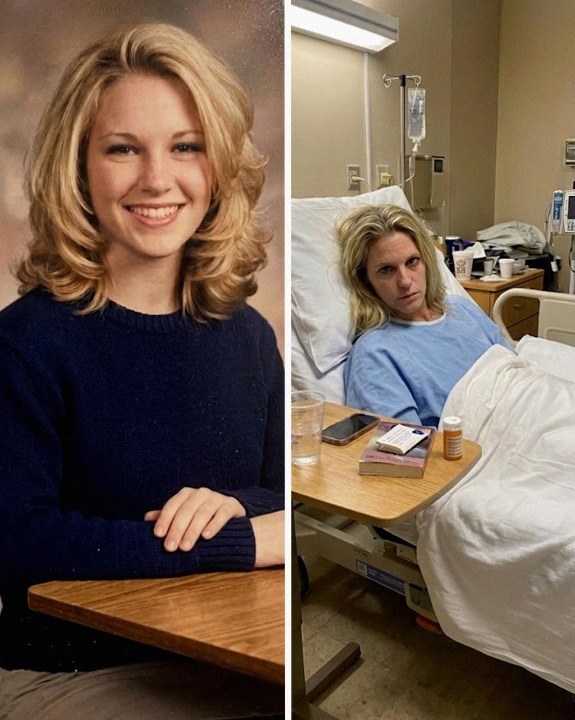
I froze the moment I saw the name on the chart.
Margaret.
For a second, I just stood there outside Room 304, clipboard in hand, trying to steady myself. The hallway buzzed with the usual morning rush, monitors beeping, carts rolling past, voices calling out updates. But all of that faded behind the weight of one name.
Twenty-five years had passed.
But some memories don’t fade with time.
I told myself it couldn’t be her. That it was just a coincidence.
But deep down, I knew better.
And when I pushed the door open, there she was.
Older, of course. Lines where there used to be none. But still unmistakably the same Margaret who had made my teenage years feel like something I had to survive rather than live.
She sat upright in the bed, scrolling through her phone, completely at ease.
“Good morning,” I said, relying on the routine that had carried me through sixteen years of nursing. “I’m your nurse today. My name is Lena.”
She barely looked up.
“Finally,” she muttered. “I’ve been waiting forever.”
Same tone.
Sharp. Dismissive.
Like no time had passed at all.
And in that moment, I made a decision.
She wouldn’t know who I was.
Back then, she had ruled the school. Perfect hair, perfect clothes, the kind of confidence that made everyone else feel smaller just by standing nearby.
And me?
I kept my head down. Wore what I could afford. Learned early how to stay invisible.
People like her forget.
People like me remember.
Every day of her stay, I did my job.
Calm. Professional. Careful.
No matter how she spoke to me. No matter how many times she snapped her fingers for attention or complained about things that didn’t matter.
I treated her like every other patient.
Because that’s what I had worked so hard to become.
Someone who didn’t let the past define how I showed up in the present.
Days passed. She improved. Her attitude didn’t.
And then came the morning she was discharged.
I went over her instructions, explained her medications, answered her questions. Standard procedure.
She listened, half-interested, already reaching for her bag.
Then, just as I finished, she looked at me—really looked at me—for the first time.
Her eyes narrowed slightly.
And then she said it.
“You should resign immediately.”
The words hit harder than I expected.
I kept my expression steady. “Is there a concern about your care?”
She gave a small, knowing smile.
“Oh, this isn’t about care,” she said. “It’s about you.”
Something in my chest tightened.
She leaned in slightly, lowering her voice.
“I know exactly who you are.”
The room went quiet.
“I remember you,” she continued. “And if the hospital knew who you really were back then… how unstable you were, the issues you had… I’m not sure they’d want you working here.”
For a moment, I couldn’t breathe.
Not because what she said was true.
But because she was still trying to control the story.
Still trying to reduce me to the girl I used to be.
I straightened, grounding myself in the present.
In everything I had built.
In everything she didn’t know.
“I’m not that person anymore,” I said calmly.
She shrugged. “People don’t change as much as they think.”
I held her gaze.
“I did.”
She studied me for a second, like she was trying to find the version of me she remembered.
But she couldn’t.
Because that version no longer existed.
“I’ve worked here for sixteen years,” I continued. “I’ve cared for hundreds of patients. I’ve earned my place.”
Her smile faded, just slightly.
“And if you have concerns,” I added, “you’re welcome to report them. I’m not afraid of the truth.”
That was something the younger version of me never could have said.
She leaned back, clearly not getting the reaction she expected.
For the first time, she looked uncertain.
I handed her the final paperwork.
“Your discharge is complete,” I said. “Take care of yourself.”
And then I walked out.
Not quickly. Not shaken.
Just steady.
Later that day, I sat in the break room, letting it all settle.
And I realized something I wish I had understood years ago.
People who hurt you don’t always change.
But you do.
And when you finally stand in a place they can’t reach anymore… their words lose the power they once had.
She walked out of that hospital thinking she could still define me.
But she was wrong.
Because I already had.