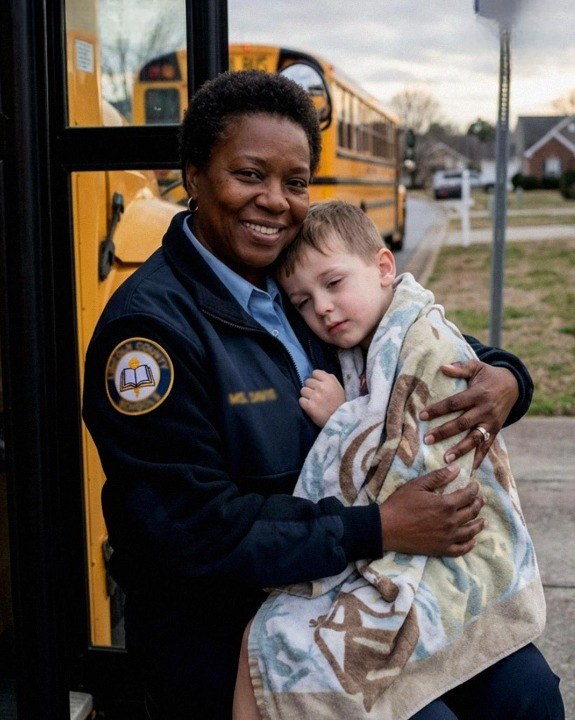
I dragged a barefoot little boy out of an icy lake, fully aware I could lose my life doing it. The police later told me I had saved him. But before I even had time to dry off, my phone buzzed with a message warning that everything was about to fall apart.
I’ve been driving a school bus for 23 years, and I’ve always taken my job seriously.
In winter, I keep a box next to my seat filled with spare mittens because there’s always at least one kid who forgets. I remind them to zip their jackets, ask how their spelling tests went, and I know exactly which kids need to sit near the window because motion sickness is real.
Taking care of them just comes naturally to me.
But one day, that instinct was used against me.
It started like any normal afternoon.
The bus was warm, Christmas lights lit up the neighborhoods, and the kids were excitedly talking about winter break. Someone in the back was singing “Jingle Bells,” completely off-key.
Then I noticed him.
A small boy, maybe six years old, running along the sidewalk straight toward the lake.
He had no coat. No shoes.
“Hey, kid!” I shouted.
He didn’t even turn around.
He kept running along the old chain-link fence, stopped just long enough to push the gate open, and continued straight through.
I slammed on the brakes. The kids shouted behind me.
“Stay in your seats!” I yelled, switching on the hazard lights before running off the bus.
“Hey! Stop!”
But he didn’t.
I watched, my heart tightening, as he ran directly toward the water.
And then he stepped right in.
The freezing water swallowed his legs as if it meant nothing.
I froze for a second.
I can’t swim.
When I was eight, my mother tried to teach me, and I panicked so badly she had to pull me out. Ever since then, I’ve avoided water completely. Lakes, pools, even baths.
That fear hit me hard as I reached the edge.
The boy flailed, turned toward me, his eyes full of panic. He tried to cry out, but water filled his mouth. Then he disappeared beneath the surface.
Gone.
I didn’t think anymore.
I ran in after him.
The cold hit me like a punch. I stumbled, nearly going under myself, but I pushed forward. His hand appeared for a split second.
I grabbed it just as he slipped under again.
My fingers closed tightly around his wrist, and I pulled him up.
He coughed violently, gasping for air, his lips already turning blue.
“I’ve got you. I’ve got you, sweetheart, I’ve got you.”
The water wasn’t deep—only up to my waist—but it felt like I was drowning anyway. My legs went numb.
Somehow, I got us back to shore.
Somehow, we made it out.
He was shaking uncontrollably, coughing and gasping. I wrapped my arms around him and rushed back to the bus.
The kids were pressed against the windows, silent, watching everything.
I grabbed every towel from the emergency kit, wrapped him tightly, turned the heat all the way up, and called dispatch.
“A child went into the lake. I got him out, but we need help.”
When the deputies arrived, they told me I had likely saved his life.
I just nodded, still holding onto my work phone from the call.
Then it vibrated.
A message notification.
I opened it.
And my stomach dropped.
It was from an unknown number.
That alone wasn’t unusual—parents sometimes used the number displayed on the bus when we were running late—but this message was different.
It wasn’t about schedules or pickups.
It was just one sentence.
Cold. Threatening.
“I saw what you did to that child — and everyone else will too.”
I looked up.
The boy sat near the heater, wrapped in towels, his cheeks slowly regaining color. One of the deputies was crouched in front of him, speaking gently.
Then I heard heels clicking on the pavement.
“I’m here. I’m here!”
A woman rushed onto the bus, out of breath, clutching her phone.
“I turned my back for one minute, and he was gone!”
“Are you his guardian?” one deputy asked.
“I’m his nanny.” She knelt in front of the boy. “What were you thinking? You’re in so much trouble.”
Then she looked up.
And I recognized her.
She sometimes picked up an older boy from the elementary school. I’d seen her before, always leaning against her car, always on her phone while kids poured out around her.
I remember thinking she should be paying more attention.
She grabbed the boy. “Come on. We’re leaving.” Then under her breath, “I better not lose my job over this.”
That night, I barely slept.
That message kept replaying in my head.
Why would someone phrase saving a child as a threat?
The answer came the next morning.
My supervisor called and told me to come in before my route.
When I sat down in his office, he turned his screen toward me.
“Have you seen this?”
It was a video.
Blurry, zoomed in—but clear enough. The boy running toward the lake. Then me entering the frame.
But the angle made it look completely different.
It looked like I had chased him… and pushed him in.
And the caption made it worse:
“I turned my back for one minute, and this woman attacked the child I was caring for.”
“That’s not what happened,” I said. “I saved him.”
“There are hundreds of comments already,” my supervisor said. “Parents have been calling since five this morning demanding you be fired.”
I watched the comments scroll:
Fire her. Arrest her. Keep her away from kids.
“Do you think I hurt him?” I asked.
“No. The deputies’ report is clear,” he said. “But people don’t read reports. They watch videos.”
I sat there, stunned.
I could lose everything for saving a child.
“Can I still drive?” I asked.
He hesitated. “For now.”
I got on the bus, hoping things would calm down.
They didn’t.
At my first stop, no one was there.
At the next, a mother pulled her daughter away the moment she saw me.
“I’ll drive you myself,” she said.
At another stop, a boy stepped halfway on the bus, then backed off.
“I’m sorry,” he said. “My mom says you’re dangerous.”
I finished my route with an empty bus.
When I parked it, I just sat there, gripping the steering wheel.
The threat made sense now.
Someone had twisted the truth on purpose.
And I knew exactly who.
That afternoon, I went to the school and waited.
When dismissal came, I saw her—the nanny—leaning against her car, glued to her phone like always.
I started recording and walked straight up to her.
“You filmed me pulling him from the lake,” I said. “And made it look like I hurt him. Why?”
She raised an eyebrow. “It’s not my fault it looked bad.”
“You knew it would. Why were you recording instead of stopping him?”
Her jaw tightened.
“I turned away for one minute,” she snapped. “He asked me to film him making a snow angel. How was I supposed to know he’d run?”
“By paying attention,” I said. “Sounds like it was longer than a minute.”
Her expression twisted with anger.
“I panicked,” she said. “I wasn’t going to lose my job over one mistake.”
“So you tried to cost me mine instead.”
Kids nearby had gone quiet. Parents started watching.
Then something unexpected happened.
One child stepped forward.
Then another.
“She wouldn’t hurt anyone,” a girl said. “You’re lying.”
“She waits for us even when we’re late,” a boy added.
More kids gathered. More parents listened.
The nanny looked around, overwhelmed.
“I didn’t think it would get this big,” she said. “I just needed to protect myself.”
I looked at her. “And I needed to save a child.”
That night, I posted the full video.
The response was immediate.
People apologized.
They demanded she be held accountable.
The next morning, my bus was full again.
Kids climbed on like nothing had changed.
Parents waved. Some apologized. Others just smiled awkwardly.
I had always believed that doing the right thing quietly was enough.
But I learned something important.
Staying quiet doesn’t mean you have no voice.
And standing up for yourself doesn’t mean you’ve lost your kindness.
Sometimes, it just means refusing to let someone else’s lie define your truth.
As I pulled away from the curb, the kids started singing again.
And this time, the road ahead felt clear.