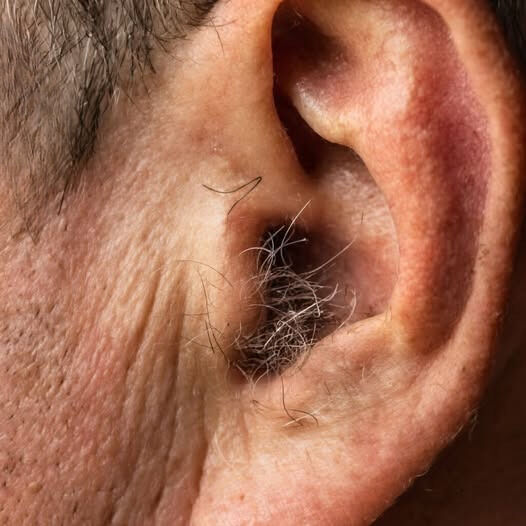
In the quiet routine of getting ready each morning, the mirror often becomes the place where we decide what feels “normal.” So when you suddenly notice a long, stubborn hair growing from your ear, it can feel like more than just a small cosmetic surprise. For many people, it triggers an uneasy thought that something in the body has changed overnight. It can bring a wave of worry—questions about health, aging, or whether something deeper is wrong.
But the truth is much simpler.
Ear hair isn’t a warning sign of illness. It’s a natural part of aging.
Our bodies are not fixed. They are constantly changing, adapting, and responding to internal shifts over time. As we get older, especially after fifty, hormones begin to behave differently. One of the key players in this process is testosterone and its byproduct, dihydrotestosterone, also known as DHT. These hormones exist in everyone, not just men, and they influence how and where hair grows.
As the years pass, hair doesn’t change evenly across the body. While hair on the scalp may begin to thin or recede, other areas—like the ears, nose, and eyebrows—can start producing thicker, more noticeable strands. This happens because hair follicles are not all the same. Each group of follicles reacts differently to hormonal signals.
In the ears, these follicles often become more sensitive over time. Their growth phase extends, and they begin producing stronger, more visible hairs. For men, this is a common part of aging. For women, similar changes may appear after menopause, when estrogen levels drop and the balance shifts slightly toward androgen activity.
Genetics also play a major role.
If ear hair was common in your family, there’s a good chance you’ll experience it too. This isn’t a flaw or something unusual—it’s simply a trait passed down through generations. In fact, these hairs once served a practical purpose. They helped protect the ear canal by trapping dust, debris, and small particles, acting as a natural barrier for a sensitive part of the body.
Despite how normal it is, ear hair is often surrounded by myths. Some people believe it signals heart problems or serious health issues, but there’s no medical evidence to support that. Others think cutting or trimming the hair makes it grow back thicker. In reality, trimming only changes how the hair feels, not how it grows.
If you choose to manage it, grooming should be done carefully. The ear canal is delicate, and using sharp tools or plucking deeply can cause irritation or injury. Safe trimming tools, like small rounded scissors or electric trimmers designed for this purpose, are the best option. Still, it’s important to understand that this is simply maintenance—not a solution to something that needs fixing.
At its core, ear hair is just another sign that your body has evolved over time.
It reflects years of change, adaptation, and life experience. Instead of seeing it as something negative or worrying, it can be viewed as a small reminder of how the body continues to function and adjust as we age.
When you understand what’s really happening, the concern fades.
There’s no hidden danger, no urgent problem—just a natural process playing out exactly as it should. Aging isn’t a failure or something to resist at every turn. It’s a progression, and even the smallest changes are part of that journey.
So if you notice a stray hair where there wasn’t one before, there’s no need to panic.
It’s simply your body doing what it has always done—changing, adapting, and moving forward with time.