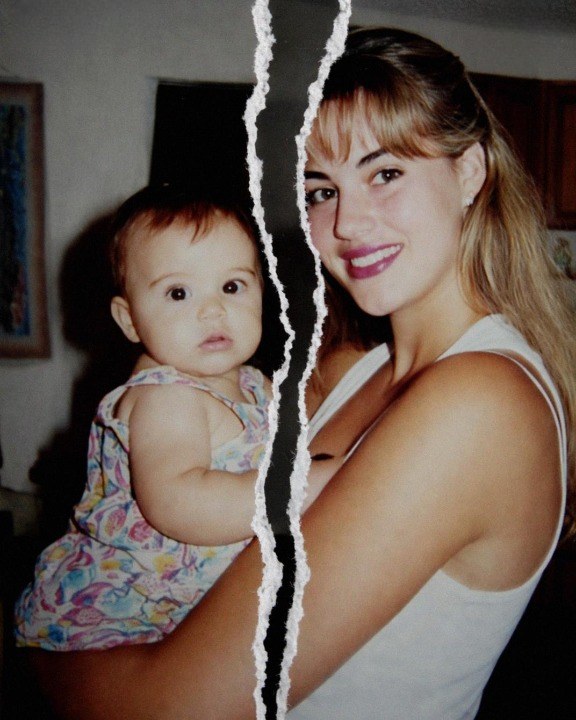
I thought I understood what abandonment felt like.
I thought it lived in the small, quiet moments. Birthdays without a card. School plays with one empty seat that never got filled. Every form that asked for a mother’s name, as if it were the most ordinary thing in the world.
I believed I had made peace with it.
Then one day, the woman I had spent my entire life writing to showed up at my front door, holding a cardboard box tied with a faded blue ribbon.
And in that moment, I realized something I hadn’t expected.
Silence wasn’t the worst thing she had given me.
For a second, I couldn’t move.
My hand stayed on the doorknob, my body refusing the simplest commands. Breathe. Speak. Step back.
She looked older than the photo I had memorized as a child. Fine lines around her eyes. Hair cut shorter than I imagined it would be. But there was no doubt.
Same mouth. Same expression.
The same quiet sadness I had tried to understand for years.
I recognized her instantly.
And somehow, that made it worse.
“I came to explain,” she said, her voice unsteady. “My letter was delayed. Can I come in?”
A hundred questions rushed through me at once.
Where had she been all these years?
Why now?
What made her think she could just arrive like this, as if time had been paused and not lived through?
I should have closed the door.
I should have asked her everything right there, without letting her take a single step further into my life.
Instead, I moved aside.
She walked in carefully, like she was afraid the floor might give out beneath her.
From the kitchen, Nate appeared, drying his hands on a towel. He looked at her, then at me, and immediately understood this wasn’t a misunderstanding. This wasn’t a neighbor stopping by.
“Liza?” he said softly.
He didn’t ask questions. He didn’t try to step in.
He simply called for our daughter, guided her gently outside through the sliding door, and paused beside me long enough to squeeze my arm.
Just once.
Steady.
Then he was gone.
And suddenly, it was just the two of us.
Me.
And the woman who had never earned the right to be called my mother.
She stood in the middle of my living room, holding that box like it was something fragile. Or maybe something heavy.
“I didn’t expect you to open the door,” she admitted.
“I didn’t expect you to show up,” I replied.
The words came out sharper than I intended, but I didn’t take them back.
She nodded, like she deserved that.
“I wrote back,” she said. “Years ago. More than once.”
I felt something twist in my chest.
“I never got anything.”
“I know,” she whispered. “That’s why I’m here.”
She set the box down on the coffee table between us, her hands lingering on it for a moment before she pulled them away.
“Everything I tried to send you… it’s in there.”
I didn’t move right away.
But eventually, I stepped closer and untied the ribbon.
Inside were letters.
Dozens of them.
All addressed to me.
Different dates. Different years. All unopened. All returned.
My name written in her handwriting over and over again.
My hands started to shake as I picked one up.
“I wasn’t allowed to contact you,” she said quietly. “Your grandparents… they made it very clear. I was young. I didn’t have the money to fight them. I thought if I waited, if I kept trying, something would get through.”
I looked up at her.
“And it didn’t.”
She shook her head.
“No.”
For a long moment, neither of us spoke.
All those years, I had believed she chose silence.
That she chose to stay away.
That every unanswered letter meant I wasn’t worth answering.
But now, standing there, holding proof that she had tried… something inside me began to shift.
Not forgiveness.
Not yet.
But something else.
Something more complicated.
“I wrote to you every year,” I said. “Birthdays. Holidays. Even when I got older and told myself I should stop.”
Her face broke at that.
“I know,” she said softly. “I kept copies of every letter I sent back… hoping one day you’d read them.”
I looked down at the box again.
At everything we had both lost to time, to silence, to decisions neither of us fully controlled.
“I don’t know what to do with this,” I admitted.
“You don’t have to decide today,” she said. “I didn’t come here expecting anything. I just… couldn’t let another year go by without trying one more time.”
Her voice trembled, but she didn’t step closer.
She didn’t reach for me.
And somehow, that mattered.
Because for the first time, she wasn’t asking for a place in my life.
She was asking for a chance to be heard.
I exhaled slowly, steadying myself.
“I can’t call you my mother,” I said.
“I understand.”
“I don’t know if I ever will.”
She nodded again, tears slipping down her cheeks.
“I understand that too.”
I looked at the letters one more time, then back at her.
“But I’ll listen,” I said.
It wasn’t forgiveness.
It wasn’t closure.
But it was something.
And for the first time in over twenty years, the silence between us finally began to break.