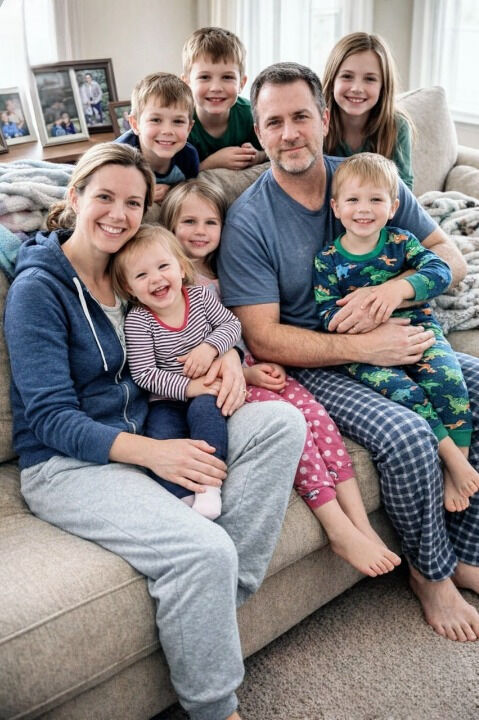
When I took in my best friend’s children, I believed the hardest part would be learning to live with the grief. I thought the sleepless nights, the sudden weight of responsibility, the daily routines, and the quiet moments of breaking down alone would be the greatest challenges I would ever face.
For years, I was convinced I understood Rachel completely. I thought I knew her past, her character, and the reasons behind every choice she made. We had been inseparable since our teenage years. We had shared secrets, laughter, and a kind of loyalty that felt impossible to break.
But years after I brought her four children into my home, a stranger appeared at my door and showed me just how wrong I had been.
Rachel and I met on our first day of high school. She sat next to me in the cafeteria simply because there were no other seats available, and we bonded over books and the questionable quality of school lunches. From that moment on, she became a permanent part of my life. We grew up side by side, navigating crushes, heartbreaks, graduation, careers, marriages, and eventually motherhood.
Rachel had a presence that made people trust her instantly. She was calm, thoughtful, and attentive. She remembered small details, birthdays, favorite snacks, the things that made people feel seen. She had a way of easing tension just by being there. Even in chaos, she brought a sense of calm.
And nothing mattered more to her than being a mother.
I saw it in how she held her babies, like they were the center of her universe. When her first child was born, she cried from happiness. By the fourth, she joked that her heart had stretched beyond its limits, but she always said it with warmth and joy.
Her husband, Daniel, adored her. Together, they built a home that felt alive—messy, loud, full of laughter and constant motion. Their house was always filled with kids running around, toys scattered everywhere, and the kind of energy that made it feel real and lived-in.
My husband and I had two children, and our families blended naturally. Holidays were shared. Vacations were chaotic but joyful. Backyard gatherings turned into long evenings of conversation while the kids played freely. Rachel and I would sit together, talking about everything and nothing.
It felt stable. Reliable. Like something that would always be there.
Then, one ordinary afternoon, everything cracked.
Daniel was involved in a traffic incident on his way home—and he never came back. I still remember the call. Rachel didn’t scream. She didn’t cry. Her voice was something worse.
Empty.
Flat.
As if her soul had stepped away, leaving only her words behind.
The days that followed felt unreal. There was a funeral, food brought by well-meaning neighbors, sympathy cards, and quiet voices trying to say the right thing. Rachel tried to stay strong for her children, but grief hollowed her out. She stopped eating properly. She barely slept. Sometimes she looked at me as if she couldn’t fully see me.
I did what I could. I showed up.
I brought groceries, helped with laundry, drove the kids to school, and sat with her in silence when words felt useless. I hoped time would ease the pain. I hoped routine would hold her together.
Then came another blow.
An aggressive illness. Advanced. The kind that leaves no room for illusions.
From that moment, I moved into survival mode for her family. I became whatever they needed. I cooked meals, even when she couldn’t eat. I cleaned, organized, managed schedules, and sat beside her during treatments, holding her hand while she tried to stay brave.
She never complained. Not once. Not when her hair fell out. Not when her strength faded. She stayed focused on her children, trying to shield them from her fear.
Six months later, she was gone.
I was there at the end, sitting beside her bed, holding her hand as her breathing changed. Her hand felt so small in mine. She looked at me like she was trying to leave something behind that would last longer than she could.
“Promise me,” she whispered. “Don’t let them be alone.”
I didn’t hesitate.
“I promise,” I said.
At the time, I thought that was the hardest thing I would ever have to do.
I was wrong.
Rachel and Daniel had no close relatives willing or able to take in four children. Some were distant. Others stepped back. Sympathy came easily, but commitment did not.
When social services contacted us, my husband and I didn’t need time to decide.
We said yes.
We adopted all four of them.
Overnight, our family grew to six children. Six personalities. Six emotional worlds. Six lives that needed stability.
The beginning was overwhelming in ways I hadn’t fully imagined.
There were sudden outbursts, deep silences, and clinginess that left me with no space to myself. There was anger that came from confusion, not defiance. Grief doesn’t make sense to children, and they didn’t know how to express it.
The youngest cried every night. The oldest withdrew in ways that scared me. Teachers called. Counselors helped. I sat by their beds night after night, repeating the same reassurance.
You’re safe.
You’re loved.
You’re not alone.
There were nights I lay awake wondering if I was enough. If love alone could carry us through.
But slowly, things changed.
Not all at once, but gradually.
They started sleeping better. They laughed again—real laughter. They found comfort in routines. They began to call me Mom, sometimes quietly, sometimes without realizing it. Every time, it caught in my throat.
We created new traditions. Celebrated birthdays. Told stories about Rachel and Daniel so they would never feel erased. We made space for grief, but we didn’t let it define everything.
Over time, life steadied.
I began to believe we had made it through the worst.
Then one afternoon, when the house was quiet and I was alone, there was a knock at the door.
Not casual. Firm.
When I opened it, a woman stood there who didn’t feel familiar in any way. She was composed, well-dressed, and carried herself with confidence. Her expression was controlled, but her eyes were sharp, as if she had prepared for this moment.
“You’re Rachel’s friend,” she said. “The one who adopted her children.”
I nodded, uneasy.
“I knew her,” she continued. “And you deserve to know the truth. I’ve been looking for you for a long time.”
My chest tightened.
“What truth?”
She handed me an envelope.
“She wasn’t who she said she was.”
Before I could respond, she turned and walked away.
I stood there, holding the envelope, feeling something heavy settle inside me.
When I went back inside, I looked down at it.
The handwriting was Rachel’s.
My legs felt weak as I sat at the table. I knew, somehow, that whatever was inside would change everything.
I opened it.
As I read, it felt like the ground beneath my life shifted.
Rachel wrote about a life she had never told me about. A past filled with wealth, influence, and control. A world where expectations suffocated her and choices were made for her.
She and Daniel had walked away from it. They changed their names. They started over quietly, building the life I had always believed was simply who they were.
For years, it worked.
Until it didn’t.
She revealed that Daniel’s death wasn’t as random as we all believed. She didn’t give every detail, but it was clear enough—people from her past had not accepted her leaving. People with power. People who didn’t let go.
When she became ill, she realized time was running out—not just because of her health, but because of the danger she feared.
And then came the truth that broke me.
She had chosen me.
Not out of convenience. Not because she had no one else.
She chose me because I was safe.
Because I was ordinary in a way that protected her children. Because I wasn’t connected to the life she had escaped. Because she trusted me to love them without conditions.
She had planned everything. Legal protections. Documentation. Safeguards to ensure no one could take the children or disrupt their lives.
She had built a shield around them without anyone noticing.
By the end of the letter, I was crying so hard I could barely see.
It wasn’t betrayal.
It was trust.
That night, I tucked all six children into bed, one by one, kissing their foreheads and adjusting their blankets.
I didn’t tell them what I had learned.
Not yet.
But as I turned off the lights, I whispered the same promise I had made before.
You are safe.
You are home.
I’m not going anywhere.
In the days that followed, I read the letter again and again. I thought about the woman who had found me. I thought about everything Rachel had carried silently.
I looked at the children differently—not because they had changed, but because I understood more of what they had come from.
They weren’t just children who had lost their parents.
They were children whose parents had fought for their future in ways I never saw.
Rachel hadn’t been running away.
She had been running toward something better for them.
And once I understood that, something inside me settled.
I didn’t need every detail.
I knew what mattered.
Protect them.
Keep their lives steady.
Give them a place where they can feel safe.
The truth didn’t threaten us.
It reminded me why she trusted me in the first place.
And if anyone ever came to that door again, I already knew what I would do.
I would stand my ground.
Because those children were no longer just hers.
They were mine.